Apollo 11 Astronaut Finally Reveals What NASA Found on the Moon
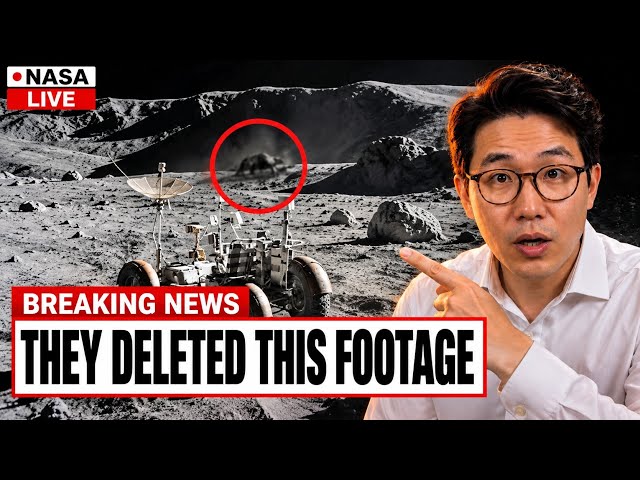
More than half a century after Apollo 11 carried Neil Armstrong, Buzz Aldrin and Michael Collins to the Moon, dramatic online claims continue to suggest that the astronauts encountered something NASA concealed from the public. The accompanying thumbnail appears to show a mysterious structure circled on the lunar horizon beside the statement “They Deleted This Footage,” but no authenticated Apollo photograph, mission recording or astronaut testimony confirms the existence of an alien building at the landing site.
What Apollo 11 actually discovered, however, was scientifically revolutionary. After landing in the Sea of Tranquility on July 20, 1969, Armstrong and Aldrin spent approximately two and a half hours exploring the surface, deploying instruments, photographing the surrounding terrain and collecting about 21.5 kilograms of rocks and soil. Laboratory analysis revealed that the Moon’s surface materials were ancient, chemically different from ordinary terrestrial rocks and shaped by billions of years of impacts, radiation and exposure to the solar wind.
The samples contained no organisms or convincing evidence of past biological activity, despite extensive tests conducted in specially controlled laboratories after the astronauts returned. NASA had taken the possibility of lunar microbes seriously enough to quarantine the crew and isolate the samples, making Apollo 11 humanity’s first direct attempt to search material from another world for signs of life. Scientists found none.
The mission nevertheless helped establish the modern theory that the Moon formed after a giant collision involving the early Earth, a conclusion strengthened by similarities between the isotopic compositions of lunar and terrestrial rocks. Apollo 11 also deployed a seismometer that recorded “moonquakes” and a laser-ranging reflector that remains usable today, allowing scientists to measure the Earth–Moon distance with extraordinary precision. Claims about deleted footage are partly fueled by a real archival controversy:
NASA acknowledged that the original telemetry tapes containing the highest-quality raw transmission of the Moon walk could not be located and were likely erased and reused during a tape shortage. However, the broadcast itself was not lost. Copies recorded by television stations and tracking facilities survived, and restored footage was later produced from the best available recordings. Nothing in the surviving audio transcripts supports stories of concealed lunar cities, spacecraft or intelligent beings.
The Apollo 11 astronauts also never produced a verified late-life confession revealing alien activity. Armstrong consistently described a barren but magnificent landscape, Aldrin explained that a light seen during the outbound flight was probably one of the spacecraft’s separated panels, and Collins reported no secret encounter while orbiting above the Moon. The most astonishing revelation was therefore not a hidden civilization but the Moon itself: an airless archive preserving evidence of the solar system’s violent early history.
Every crater, fragment of glass and grain of dust helped scientists reconstruct processes that Earth’s weather and geology have largely erased. Decades later, those carefully preserved Apollo samples are still being opened with modern instruments, proving that the mission’s genuine discoveries remain more valuable—and more enduring—than the sensational secrets imagined around them.