James Webb Just Detected a Signal From Another Universe!
WASHINGTON — An extraordinarily faint infrared signal captured by NASA’s James Webb Space Telescope has ignited speculation that humanity may have received its first glimpse of something beyond our universe, but astronomers are urging the public to separate an exciting mystery from an extraordinary claim that remains unsupported by evidence. The signal was identified while researchers examined an exceptionally deep Webb observation containing some of the oldest light ever detected.
It appears as a tiny, intensely red source whose light has been stretched to infrared wavelengths during its immense journey through expanding space. Initial analysis suggests that the radiation may have originated when our universe was only a few hundred million years old, placing its source close to the period known as cosmic dawn, when the first generations of stars, galaxies, and black holes began transforming the darkness following the Big Bang.
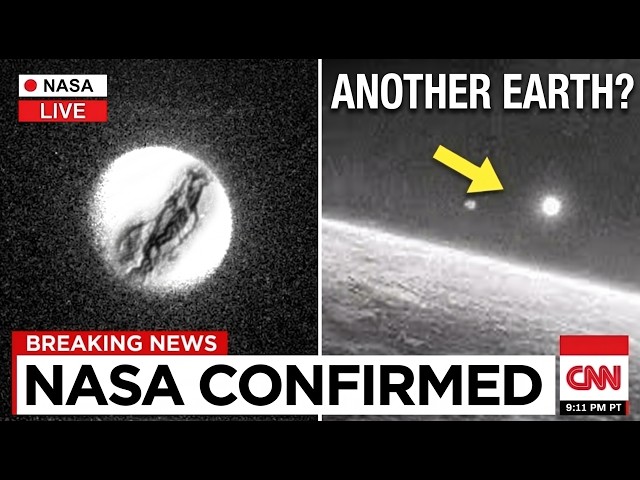
However, no official NASA announcement has confirmed communication with another universe, and the object shown in the accompanying viral thumbnail is not a verified image of another Earth, a portal, or an inhabited world. Webb does not listen for radio messages in the way a communications antenna does; it detects infrared light and separates that light into spectra, allowing scientists to identify chemical elements, estimate distances, and study the physical properties of extremely remote objects.
The word “signal” in this context therefore refers to measurable electromagnetic radiation rather than an intentional transmission. One plausible explanation is that Webb has detected an unusually bright early galaxy, perhaps powered by rapid star formation or a feeding supermassive black hole. In January 2026, NASA reported that Webb had confirmed the galaxy MoM-z14 as it appeared only 280 million years after the Big Bang. Its light traveled through space for approximately 13.5 billion years before reaching the telescope, and its unexpected brightness challenged predictions about how rapidly galaxies could develop.
Details of that discovery are available in NASA’s official Webb report. More conventional possibilities for an anomalous source include gravitational lensing, overlapping foreground objects, detector noise, or a previously unknown type of active galaxy. The far more dramatic “another universe” interpretation originates from speculative cosmological theories suggesting that our universe could be one member of a larger multiverse. Some models propose that collisions between separate cosmic regions might leave subtle patterns in ancient radiation, but no observation has yet provided generally accepted proof that other universes exist, much less that Webb has detected a message from one.
Researchers must now repeat the observation, rule out instrumental artifacts, and obtain a spectrum precise enough to determine the source’s redshift and chemical signature. Independent teams would also need to reproduce the result before scientists could consider explanations involving new physics. Even if the source proves to belong entirely to our own cosmos, its extreme distance could make it scientifically historic, offering new information about the first stars and the unexpectedly fast emergence of early galaxies.
For now, Webb has not opened a window into another universe—but it may have captured a whisper from an era of our own universe that remains almost completely unknown.