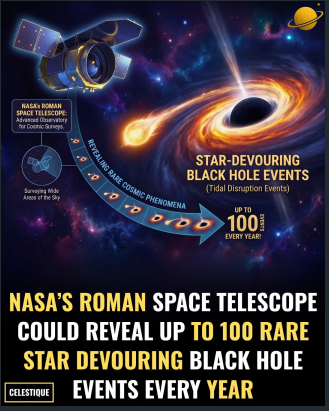
Black holes are often invisible, but they become spectacularly bright when a wandering star drifts too close and is torn apart by their immense gravity. These dramatic events, known as tidal disruption events, release enormous amounts of energy that can briefly outshine an entire galaxy.
NASA’s Nancy Grace Roman Space Telescope is expected to help scientists detect up to 100 of these rare cosmic events each year, providing valuable clues about how supermassive black holes formed and evolved across billions of years. Combined with observations from other powerful observatories, these discoveries could transform our understanding of the hidden universe.