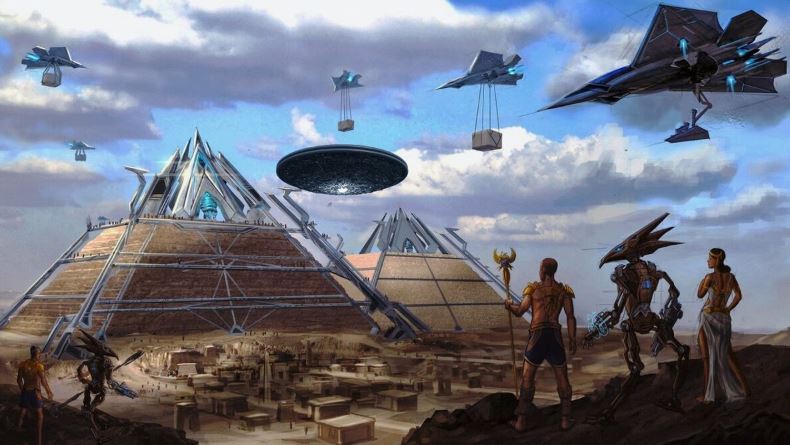
Various studies over the years have provided information about an ancient civilization. Supposedly, what we remember today as Atlantis existed at that time. It was during this time that a new civilization may have emerged, which came to be known as the Osirian civilization. According to data published by some researchers, this civilization was impressively advanced, especially for the era in which they lived.

They even possessed ships similar to the Hindu vimanas . The beginning of the Osirians According to mythological records, this civilization was created by the god Osiris. In Egyptian records, he is the son of Nut, the goddess of the sky, and Geb, the god of the earth. The name Osiris is also believed to derive from the Greek word “Asar” or “User.” This was one of the most advanced civilizations of its time, 16,000 years ago. They had roads, incredible cities, and trade routes with great potential.
The technology of the ancient Osirian people As surprising as it may seem, considering this civilization lived 16,000 years ago, they possessed a wealth of technology. For example, they are believed to have been able to build earthquake-proof buildings. They also had vimana-like flying craft and numerous means of transportation. Thus, at first glance, it’s clear that these people had a futuristic mentality and lived accordingly. Is Baalbek an Osirian creation? Apparently, this civilization had various means of transportation, so it’s quite possible they used them to transport stones.

This brings us to Baalbek, which remains an architectural mystery to this day. It is built with the largest stones in the world, some of which measure 24 meters long and 4 meters wide. They are estimated to weigh between 1,200 and 1,500 tons. Is it possible that such colossal blocks of stone could have been handled? Where was this civilization located? According to mythology, the Styx was considered the river of the underworld. Furthermore, Osiris was considered the god of rebirth. What we know today as the Nile River was once considered the River Styx.
Not only did the name change, but so did the river’s course. It did not flow into the Mediterranean Sea, which did not exist at that time, but continued flowing toward the Valley of Osiris. From there, it continued flowing and eventually reached the deepest part of the valley, where the Mediterranean Sea now lies, forming a lake. Further on, it flowed between Malta and Sicily, heading south to Sardinia and emptying into the Atlantic at Gibraltar. Thus, this great valley, along with the Sahara, was the territory inhabited by the Osirian people.
The End of the Osirians During the destruction of Atlantis, a major change occurred. We’re talking about the fact that the Atlantic Ocean made a huge shift, and the River Styx completely changed its course. All these events caused the Mediterranean Sea basin to be completely flooded. At the same time, the resulting flood of water destroyed almost all the Osirian cities in its path. This tragedy forced them to move to higher ground, where they gradually disappeared.
This hypothesis is supported by the megalithic remains of several unknown ancient civilizations discovered in the Mediterranean; remains that do not fit into the established historical canon. It seems that the few surviving Osirian peoples dispersed and spread across different regions, creating cultures like the Egyptian one. Although traditional archaeology opposes the existence of the Osirian civilization or considers it simply a myth, some findings suggest that it did exist.