“Massive Rectangular UFO Near the Sun”? Viral Post Claims Scientists Are Searching for Answers, but the Evidence Does Not Support It
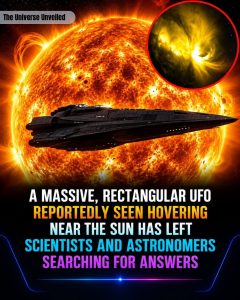
A graphic circulating on social media claims that a “massive, rectangular UFO” has been “reportedly seen hovering near the Sun,” leaving “scientists and astronomers searching for answers.” The post, branded with the name of a page called The Universe Unveiled, pairs a dramatic image of a dark, angular spacecraft in front of a blazing solar disk with a small red-circled inset showing a glowing patch of the Sun. It names no scientist, observatory, or space agency, and no established news organization or scientific body has been identified as confirming any such object.
What the graphic shows
The main image presents the Sun as a vivid orange sphere, its surface covered in bright granules, dark sunspots, and looping arcs of plasma at the edges. In front of it floats a long, wedge-shaped vessel with a layered, plated hull, a cockpit-like canopy at the rear, and rows of tiny lights along its sides. The craft is rendered in sharp, high-contrast detail, while the Sun behind it appears softer and more textured.
In the upper right, a circle outlined in red zooms in on a region that looks like a typical solar image: bright yellow loops of magnetic field lines curving around a pair of intense spots against a dark background. Below the images, large multicolored text states the claim.
What the graphic does not show is just as telling. The spacecraft is not visible in the inset, which is the part that resembles genuine solar data. No date, instrument name, wavelength, or credit identifies where the inset came from. Nothing links the dramatic ship image to any observation.
Two images, two very different origins
The most useful observation is how differently the two elements look. The Sun in the background has the texture and color palette of stylized solar art, and the inset resembles the extreme-ultraviolet images that solar observatories routinely publish, in which active regions appear as glowing arcs of hot plasma. The spacecraft, by contrast, has crisp panels, symmetrical lighting, and a cinematic composition more typical of rendered or AI-generated artwork than of any instrument image. Real solar telescopes do not produce pictures with this kind of detail on a foreign object, and no spacecraft of this apparent scale has been reported by any observatory.
None of this proves what any original source contained, since promotional graphics are often assembled from several pictures. But it does mean the ship image should not be treated as evidence of a real observation.
Why “near the Sun” claims keep appearing
Claims of strange objects near the Sun have a long history online. Solar observatories publish public image feeds, and anyone can browse them and spot odd-looking shapes. Many of those shapes have well-understood explanations:
- Cosmic-ray hits and detector noise that leave bright specks or streaks on camera sensors
- Comets and other small bodies that pass close to the Sun, which have been observed by solar instruments many times
- Image-processing artifacts, such as compression blocks, ghosting, and edge effects from stacking multiple exposures
- Instrument features, such as lens flare, reflections inside the optics, and the occulting disk used to block the Sun in coronagraphs
- Coronal mass ejections, which are enormous clouds of plasma that can look like structured shapes in processed images
Because solar images are often shown in false color and with heavy contrast adjustments, ordinary features can look dramatic and unfamiliar to people who do not know how the instruments work.
The problem of scale and heat
The idea of a large, solid craft hovering “near the Sun” also runs into basic physics. Space near the Sun is an extreme environment, with intense radiation, enormous heat, and powerful magnetic activity. Spacecraft that approach it, such as dedicated solar probes, rely on specially designed heat shields and operate on carefully planned trajectories published well in advance. A “massive” vessel would also have to be viewed at some distance, and the title offers no figure for its size or distance. Judging size from a single image is notoriously unreliable, because a small artifact on a sensor can look identical to a huge object far away.
What a real discovery would look like
If astronomers truly detected an artificial object of enormous size near the Sun, the evidence would be extensive and public. Multiple independent observatories on Earth and in space would record it. Data would be released through scientific channels, and papers would be submitted for peer review. Space agencies would hold briefings, and universities and amateur astronomers around the world would analyze the images. The story would appear across major news outlets within hours, with named experts explaining what they found.
The post refers only to scientists and astronomers in general terms, and “reportedly seen” is a phrase that points to no actual report. So far, no such independent trail has been identified.
The language of “searching for answers”
The closing line, “has left scientists and astronomers searching for answers,” is a familiar device. It implies that experts are baffled, which lends weight to the claim, yet no expert is named and no statement is cited. Phrases such as “reportedly” and “searching for answers” allow a post to suggest a mystery without committing to anything that can be checked. In practice, when scientists encounter something odd in solar data, they usually identify the cause quickly and explain it in public, since solar physics is a well-instrumented field with many overlapping observations.
The anatomy of a viral graphic
The post follows a recognizable formula:
- A dramatic composite image that places a familiar cosmic object next to an invented one
- A zoomed-in inset with a red circle that mimics scientific analysis and implies a hidden discovery
- Hedged but alarming wording such as “reportedly seen” and “searching for answers”
- An authoritative-sounding page name that suggests an educational or news source
- Bold, multicolored text designed to stand out in a crowded feed
These elements are effective because they trigger quick emotional reactions and are easy to share. They are also easy to produce, and AI image tools now make it possible to create convincing spacecraft artwork in minutes. A viewer cannot tell from a graphic alone whether any underlying observation exists.
How to check a claim like this
Media-literacy specialists suggest a straightforward process:
- Look for named sources. Does the post cite a specific observatory, instrument, scientist, or paper?
- Search for independent coverage. Check the websites of space agencies, university observatories, and established science news outlets.
- Find the original image. Solar observatories publish their data publicly, with dates, wavelengths, and credits. A real image can be traced back to its archive.
- Reverse-search the artwork. Tools that trace image origins can reveal whether the ship comes from an AI gallery, a game, or a film.
- Check the page. Does it have a record of verified reporting, or mainly sensational posts?
Why this content spreads
Curiosity about space is powerful, and the idea that something unknown is lurking beside our own star is gripping. A vivid image, a vague claim of expert confusion, and a pinch of mystery make an almost perfect engagement formula. Platforms reward strong reactions, so each comment, share, and debate helps a post travel, regardless of accuracy. There is also a cost. Fabricated or exaggerated science stories can erode trust in genuine research, and they can make it harder for audiences to take well-documented discoveries seriously.
The bottom line
As it stands, there is no verified evidence that a massive rectangular UFO has been seen near the Sun. The spacecraft in the graphic appears to be a digitally created image, the inset does not show any such object, and no credible scientist, observatory, or news outlet has backed up the claim.
The Sun remains one of the most closely watched objects in science, and its activity, from flares to ejections of plasma, is endlessly fascinating on its own. Unusual features in solar images deserve careful, evidence-based investigation, but that work depends on data from named instruments, not dramatic artwork. Until reliable reporting, expert analysis, or verifiable original observations emerge, this story is best treated as a viral curiosity: striking to look at, impossible to confirm, and a reminder to ask who made an image, and why, before believing it.
Nếu bạn muốn, mình có thể viết lại bài này theo giọng giật gân kiểu YouTube hoặc rút gọn còn khoảng 500 từ.