“Viral UFO Videos That Has Everyone Freaking Out”: “Enhanced Footage” Raises Questions About What Viewers Are Really Seeing
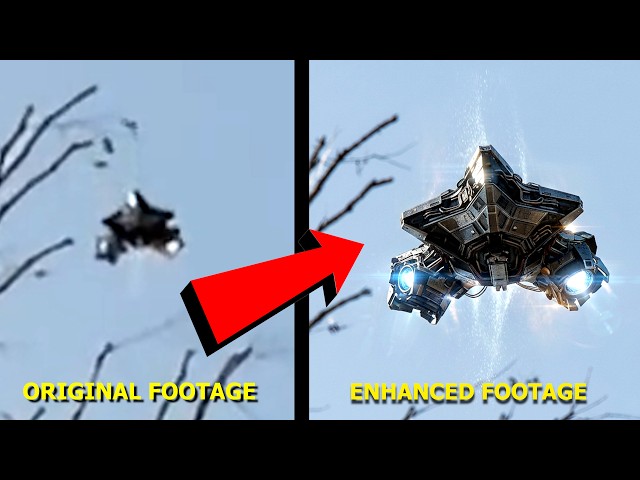
A video titled “Viral UFO Videos That Has Everyone FREAKING Out!” is circulating online, led by a thumbnail that compares “original footage” of a small, blurry object in the sky with “enhanced footage” showing what looks like a detailed, armored spacecraft with glowing blue engines. A bold red arrow links the two halves. The title claims that the clips have caused widespread alarm. It names no location, date, or witness, and no scientific body, government agency, or established news organization has been identified as confirming that the object is anything unusual.
What the thumbnail shows
The left panel is labeled “Original Footage.” It shows a tiny, dark, irregular shape suspended against a pale, overcast sky, with the bare branches of a tree crossing the frame. The object is only a few dozen pixels across, and its outline is soft and indistinct. A couple of small specks hover nearby.
The right panel, labeled “Enhanced Footage,” shows the same sky and the same branches, but the object is replaced by a large, sharply rendered craft. It has a star-shaped upper hull, layered metallic plating, mechanical details, and two bright blue thrusters that throw off rays of light. The branches in the background match those on the left, which suggests the panels were made from the same frame.
The central problem with “enhancement”
The most important point is simple: enhancement cannot create information that was never recorded. A blurry object a few pixels wide does not contain the data needed to reveal armor plating, panel seams, or engine housings. Standard processing, such as sharpening, contrast adjustment, noise reduction, and upscaling, can make an image look cleaner, but it cannot recover detail that the camera never captured.
When software appears to add detail to a low-resolution image, it is usually guessing. Modern AI upscalers and image generators fill gaps by predicting what a plausible image might look like, based on patterns learned from millions of other pictures. The result can be impressive and entirely fictional. If the source is a blurry dark shape, an AI tool may turn it into a spaceship, a bird, a drone, or a piece of debris, depending on the prompt or the model’s tendencies. The detail in the right panel is therefore not evidence about the object. It is evidence about the tool, or about the person who created the image.
That is why the “enhanced” panel should be treated as an illustration, not as a revelation. If anything, the comparison shows how far the right-hand image departs from the recorded footage.
What the original footage could be
The left panel is the only part that may reflect an actual recording, and even it is far from conclusive. A small, dark, blurry shape near tree branches has many possible explanations:
A bird or insect close to the lens, whose motion blur can create odd shapes
A drone, which is common in many areas and often looks irregular at a distance
A piece of debris, such as a plastic bag, leaf, or seed pod caught on the wind
A balloon or kite drifting in the sky
A lens artifact or compression noise, especially in zoomed-in or re-uploaded video
The nearby specks suggest small airborne particles or insects, which supports the more ordinary explanations, though a still image cannot settle the question. Judging size and distance from a single frame is notoriously difficult. A small object near the camera can look like a large object far away, and the reverse.
“Everyone freaking out”: the language of viral panic
The phrase “has everyone freaking out” is a standard device in online video. It suggests a groundswell of public alarm, which encourages viewers to join in and not be left out. But the title provides no evidence that anyone is actually alarmed, let alone “everyone.” There are no named witnesses, no statements, and no figures. The claim describes a mood, not an event.
Titles of this kind often promise “videos,” in the plural, which implies a pattern. Yet the thumbnail shows only one object, and a compilation of unverified clips does not become stronger simply because there are more of them. Each clip must be traced to its original source before it can be evaluated.
What strong evidence looks like
Researchers who study unidentified aerial phenomena generally look for more than a single clip. Strong cases usually include:
The original, unedited video file, ideally with metadata showing the time, date, and device
Multiple independent recordings from different angles, which allow the object’s size, distance, and motion to be estimated
Corroborating data, such as radar records, flight-tracking information, or drone registrations
Named witnesses who can be interviewed
Expert analysis that rules out ordinary explanations
A thumbnail with an “enhanced” version offers none of these. In fact, a clearly generated or heavily altered image can make a case weaker, because it muddies what was recorded and what was added.
The anatomy of a clickbait package
The thumbnail relies on a familiar formula:
A before-and-after comparison that suggests hidden truth was uncovered by technology
A giant red arrow that implies something important lies in the transformation
Alarming language such as “freaking out,” built to provoke curiosity and fear
Technical-sounding labels such as “original” and “enhanced” that lend an air of forensic analysis
Glowing, cinematic details that make the enhanced version look more dramatic than any real camera could capture
These elements are effective because they trigger fast emotional reactions. They are also easy to reproduce, and AI image tools now make it possible to turn a blurry speck into a convincing spacecraft in minutes. A viewer cannot tell from a thumbnail alone whether the underlying video shows a genuine recording, a staged clip, a computer-generated insertion, or recycled footage from elsewhere.
How to check a claim like this
Media-literacy specialists suggest a straightforward process:
Look for the original. Find the earliest upload and compare it with the version being promoted.
Ask what was done to the footage. If it was “enhanced,” find out which tools or methods were used.
Look for specifics. Does the video name a place, a date, and a source?
Search for independent coverage. Check established news outlets and official agency websites.
Reverse-search the image. Tools that trace image origins can reveal whether a picture comes from an AI gallery, a game, or a film.
Check the channel. Does it have a record of verified reporting, or mainly sensational titles?
Why this content spreads
Curiosity about the unknown is powerful, and the idea that technology can reveal what the naked eye missed is especially appealing. A before-and-after image gives viewers the feeling of discovery, as if they are peeking behind a curtain. Platforms reward strong reactions, so each comment, share, and debate helps the video travel, regardless of accuracy. There is also a cost. Fabricated or exaggerated “enhancements” can mislead audiences about what real footage contains and make it harder for people to take well-documented cases seriously.
The bottom line
As it stands, there is no verified evidence that the object in the left panel is anything other than an ordinary, unidentified speck in the sky, and nothing to suggest it resembles the craft shown on the right. The “enhanced” image appears to be a digital creation, since the detail it contains could not have been recovered from the original, and no credible source has backed up the video’s claims.
Unidentified aerial phenomena remain a legitimate subject of study, and unexplained reports deserve careful, evidence-based investigation. But that work depends on data, not dramatic artwork. Until reliable reporting, expert analysis, or verifiable original footage emerge, this video is best treated as a viral curiosity: striking to look at, impossible to confirm, and a reminder that an “enhanced” image can show you what software imagines, not what a camera saw.