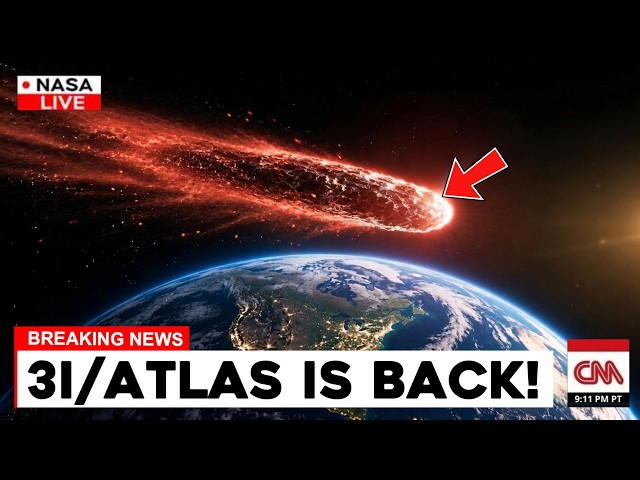
3I ATLAS IS BACK! James Webb Just Found Something STRANGE Inside the Interstellar Visitor
BREAKING SPACE NEWS: The mysterious interstellar visitor 3I/ATLAS has revealed another extraordinary secret. Observations from NASA’s James Webb Space Telescope have uncovered unusual chemical signatures inside the comet, including methane and exceptionally high levels of heavy hydrogen. These discoveries are giving astronomers a rare opportunity to investigate material that may have formed billions of years before our own Solar System existed.
Discovered in July 2025, 3I/ATLAS is the third confirmed interstellar object detected passing through our Solar System. Unlike ordinary comets, which formed around the Sun, this visitor originated beyond our planetary neighborhood. Its journey offers scientists a rare opportunity to examine material created in another star system without having to travel beyond the Solar System.
As 3I/ATLAS moved away from the Sun following its closest approach, astronomers directed the James Webb Space Telescope toward it for a closer examination. Using its Mid-Infrared Instrument, Webb collected the first mid-infrared chemical fingerprint of an interstellar object. The observations directly revealed methane gas escaping from the comet, marking the first detection of methane on an interstellar visitor.
Why is this discovery so interesting?
Methane is highly volatile, meaning it can turn from solid ice into gas relatively easily. Scientists believe some of the methane inside 3I/ATLAS may have remained buried beneath its surface, protected from sunlight and heat. As the comet approached the Sun, increasing temperatures may have reached deeper icy layers, allowing the trapped methane to escape into space.
Webb also detected an unusually high abundance of carbon dioxide compared with water. This chemical combination suggests that 3I/ATLAS formed under conditions very different from those experienced by most comets in our Solar System. Its chemistry may preserve clues about the temperature, radiation, and environment of the distant planetary system where it was born.
But the surprises did not end there. Additional Webb measurements revealed exceptionally high levels of deuterium, a heavier form of hydrogen found in water. The measured abundance was approximately 30 times higher than in typical Solar System comets. Researchers also identified unusual carbon isotope ratios, strengthening the possibility that this object formed in an ancient, extremely cold environment.
Based on these chemical fingerprints, scientists estimate that 3I/ATLAS could have formed approximately 10 to 12 billion years ago. If that estimate is correct, the comet may be more than twice as old as our Solar System, making it an extraordinary natural time capsule from the early history of the Milky Way.
Even more recently, research published in October 2026 revealed another remarkable finding: methane in 3I/ATLAS contains an exceptionally high proportion of deuterium. This provides another clue about the cold and unusual environment in which its icy materials may have formed.
Despite the dramatic headlines surrounding the object, scientists have not found evidence that 3I/ATLAS is an artificial spacecraft or an extraterrestrial probe. Its unusual chemistry is scientifically significant, but the observations are consistent with a natural interstellar comet.
The real mystery is what this ancient visitor can teach us about planetary systems beyond our own. Every chemical signal provides another clue about how planets, comets, and potentially life-supporting ingredients develop throughout the galaxy.
Could 3I/ATLAS be carrying chemical clues from a planetary system billions of years older than ours? What do you find most fascinating about this mysterious interstellar visitor: its hidden methane, unusual chemistry, or ancient origin? Share your thoughts in the comments!