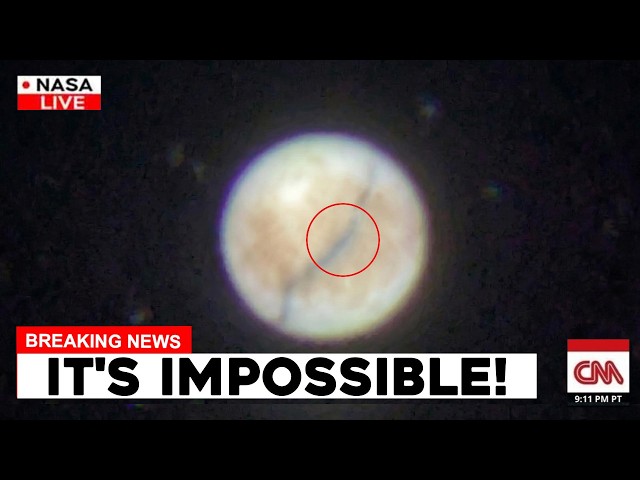
James Webb Just Saw Europa for the First Time — And It’s Terrifying
NASA’s James Webb Space Telescope has revealed fascinating details about Europa, one of Jupiter’s most mysterious moons, uncovering chemical clues that could change how scientists understand the possibility of life beyond Earth. Hidden beneath a thick shell of frozen water, Europa may contain an enormous ocean of liquid water. Now, Webb’s infrared observations have provided scientists with an extraordinary glimpse into the chemistry of this distant world.
Although the headline suggests Webb has just seen Europa for the first time, the telescope actually captured and studied the moon in 2022, with NASA announcing its major findings on September 21, 2023. The discovery was remarkable: scientists detected carbon dioxide concentrated in a region called Tara Regio, an unusual landscape covered with fractured and disrupted ice.
Why is this discovery so important? Carbon is one of the essential chemical elements required for life as we know it. Scientists already suspected that Europa possessed a vast salty ocean beneath its icy exterior, but they still needed to understand whether this hidden ocean contained important ingredients for biological processes.
Webb’s observations provided a significant clue. The distribution of carbon dioxide on Europa suggests that the carbon may have originated inside the moon rather than arriving through impacts from meteorites. Researchers believe material from the subsurface ocean may have traveled upward through cracks and geological disruptions in the ice, eventually reaching the surface.
The most intriguing location is Tara Regio, a region where Europa’s icy crust appears to have been broken apart and rearranged. Scientists call this type of terrain chaotic terrain because its surface contains disrupted blocks of ice and unusual geological patterns. The concentration of carbon dioxide in this area suggests that the surface and the hidden ocean may be connected through geological processes.
But there is another mystery. Could Europa be releasing water into space through enormous underground cracks? Scientists have previously reported possible water-vapor plumes rising from its surface. Webb investigated this possibility but did not detect an active plume during its observations. This does not completely rule out the existence of intermittent eruptions, which may occur only under particular conditions.
The implications are enormous. If Europa’s ocean contains liquid water, carbon, and other essential chemical ingredients, it could potentially provide some of the conditions necessary for life. However, scientists have not discovered organisms or confirmed that life exists beneath its frozen surface. Chemical ingredients alone are not proof of biology.
NASA’s Europa Clipper mission, launched in October 2024, is now traveling toward Jupiter to investigate this mysterious moon. The spacecraft is expected to arrive in 2030 and conduct dozens of close flybys, examining Europa’s ice shell, surface composition, and potential habitability.
Perhaps the most unsettling possibility is that an ocean containing important ingredients for life could exist beneath an apparently lifeless world, hidden from view for billions of years.
What do you think lies beneath Europa’s frozen surface? Could this distant ocean contain microscopic alien life, or is it simply a fascinating chemical environment waiting to be explored? Share your theories in the comments!