NASA Detected a STRANGE Signal From Space — And Nobody Knows What It Means

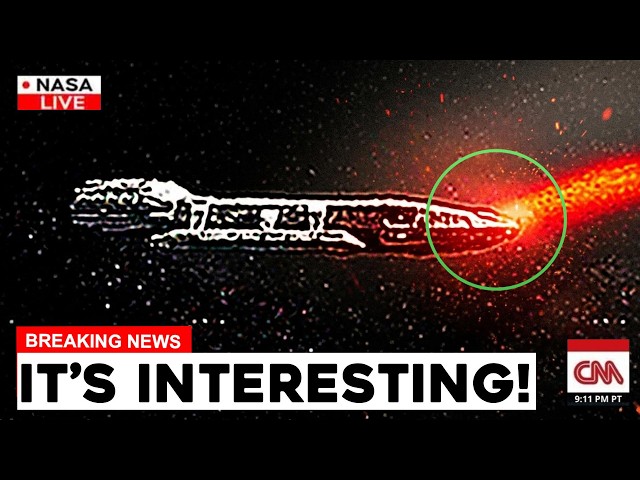
A mysterious signal from the depths of space has reignited one of astronomy’s most fascinating questions: Could the universe be sending us a message that scientists have yet to understand? A dramatic image circulating online appears to show an elongated, metallic-looking structure surrounded by darkness, with a brilliant red-orange burst of energy emerging from one end. The unusual formation has inspired speculation about unidentified cosmic objects, powerful energy emissions, and even the possibility of advanced extraterrestrial technology. But while the image suggests an extraordinary discovery, there is no verified evidence that it depicts a newly detected NASA signal or an artificial object transmitting messages toward Earth.
The search for mysterious signals is nevertheless a genuine and important part of modern astronomy. Scientists regularly detect unusual bursts of electromagnetic radiation originating from distant stars, galaxies, and other cosmic environments. Some signals last only milliseconds, while others repeat over hours, days, or even years. Their unexpected behavior can challenge existing explanations and occasionally reveal entirely new classes of astronomical phenomena.
Among the most fascinating examples are fast radio bursts, commonly known as FRBs. These extraordinarily powerful flashes of radio energy can release enormous amounts of energy in a fraction of a second. The first recognized FRB was discovered in archival telescope data in 2007, and astronomers have since identified many more.
For years, their origins remained one of astronomy’s greatest mysteries. Today, scientists have strong evidence linking at least some fast radio bursts to magnetars, highly magnetized neutron stars formed after the deaths of massive stars. However, researchers are still investigating whether every FRB can be explained by the same physical processes.
Another extraordinary example is the famous Wow! signal, detected by Ohio State University’s Big Ear radio telescope in 1977. The powerful, narrowband radio signal attracted international attention because its characteristics initially appeared interesting to researchers searching for extraterrestrial intelligence.
Despite numerous attempts to investigate its origin, the signal was never conclusively explained or reliably detected again. It remains an intriguing historical observation, but not confirmed evidence of an alien civilization.
Modern telescopes are now discovering an even wider variety of unusual cosmic emissions. Some neutron stars produce repeating radio pulses with remarkable regularity, while certain distant galaxies generate energetic radiation associated with supermassive black holes.
Black holes themselves can create some of the universe’s most spectacular phenomena. As matter spirals toward a black hole, it can become extremely hot and emit powerful radiation. In some systems, magnetic fields help launch enormous jets of energetic particles traveling at speeds approaching that of light.
These jets can extend across extraordinary distances, creating structures that appear almost artificial in astronomical images.
The strange elongated object shown in the thumbnail could visually resemble a spacecraft or a cosmic energy source, but its appearance alone cannot establish its identity. Without an original scientific image, telescope information, or accompanying observational data, its physical nature cannot be determined.
NASA’s space observatories, including the James Webb Space Telescope, Chandra X-ray Observatory, and Fermi Gamma-ray Space Telescope, investigate different forms of cosmic radiation. Their combined observations help scientists understand violent stellar explosions, black holes, distant galaxies, and other extreme environments.
However, a mysterious astronomical signal does not automatically indicate intelligent extraterrestrial activity.
Natural processes can generate remarkably complex patterns, including repeating pulses, narrow emissions, and sudden bursts of energy. Scientists must examine a signal’s frequency, duration, polarization, location, and behavior before considering more extraordinary explanations.
Researchers searching for extraterrestrial intelligence also monitor the universe for possible technological signatures. These could theoretically include artificial radio transmissions or concentrated laser emissions produced by advanced civilizations.
But identifying a genuine extraterrestrial transmission would require repeated observations, independent confirmation, and the careful elimination of natural and human-made sources of interference.
The universe contains countless phenomena that remain incompletely understood, and every unusual observation presents an opportunity to improve scientific knowledge.
Ultimately, NASA has not confirmed that the object depicted in this image represents an alien spacecraft or an extraterrestrial message. The dramatic visual should be treated as illustrative or unverified rather than authenticated scientific evidence.
Yet the underlying scientific mystery remains extraordinary. Somewhere among billions of galaxies, unusual signals continue traveling through space, carrying information about environments that humanity has barely begun to explore.
Some may originate from collapsing stars, powerful magnetic fields, or matter falling toward black holes. Others may reveal physical processes that astronomers have not yet fully explained.
And perhaps one day, scientists will detect a signal whose characteristics cannot be attributed to any known natural phenomenon.
Such a discovery would demand extraordinary scrutiny, but it could also transform humanity’s understanding of intelligence and life beyond Earth.
For now, the greatest mystery is not whether every strange signal comes from aliens, but how much of the universe remains unexplored.
What do you think? Could one of the mysterious signals detected by astronomers eventually turn out to be a message from an advanced extraterrestrial civilization, or are these strange emissions evidence of cosmic phenomena we have yet to understand? If scientists received a repeating signal from a distant star system tomorrow, would you believe it was natural or artificial? Share your thoughts in the comments!