James Webb Just Confirmed Something Is Wrong With Our Universe
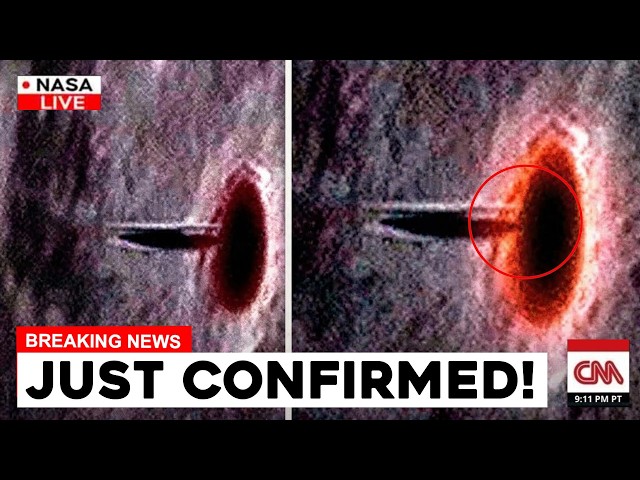
A growing scientific mystery surrounding the James Webb Space Telescope has reignited questions about whether humanity fully understands the universe. Since beginning scientific observations in 2022, NASA’s powerful infrared observatory has revealed unexpectedly bright galaxies, surprisingly mature cosmic structures, and intriguing evidence about the universe’s earliest stages. These discoveries have challenged astronomers to reconsider how quickly galaxies formed after the Big Bang. Meanwhile, a dramatic image circulating online appears to show a mysterious dark opening surrounded by a glowing red ring, with an unusual object extending toward its center. The sensational imagery has encouraged speculation about cosmic portals, black holes, and hidden dimensions. But has the James Webb Space Telescope really discovered something fundamentally wrong with our universe, or are scientists witnessing the normal process of scientific theories being tested by extraordinary new observations? Although Webb has revealed genuine cosmological puzzles, NASA has not confirmed the existence of a cosmic portal or a breakdown of the laws of physics.
One of the most significant mysteries involves the surprisingly bright galaxies detected in the early universe. According to established cosmological models, the first galaxies developed as gas accumulated inside dark matter structures, eventually producing stars and increasingly complex systems. Webb has identified distant galaxies whose light began traveling toward Earth when the universe was only a few hundred million years old. Some appeared brighter or more developed than researchers initially expected, raising questions about how efficiently stars could form during this early period. Scientists are now examining whether these galaxies contain unusually active star formation, powerful black holes, or stellar populations that differ from earlier assumptions.
Another major scientific debate concerns the expansion rate of the universe. Astronomers have discovered a persistent disagreement between measurements based on the nearby universe and predictions derived from observations of the early cosmos. This discrepancy, commonly known as the Hubble tension, has become one of modern cosmology’s most important unresolved problems. The James Webb Space Telescope has helped researchers examine certain possible sources of measurement error, including the effects of crowded stellar fields on distance estimates. Its observations have strengthened the case that the discrepancy deserves further investigation, although they have not established a definitive explanation.
The mysterious image accompanying the viral headline adds another dimension to the story. It depicts what appears to be a dark circular region surrounded by intense reddish illumination, with a narrow structure seemingly extending toward its center. Some viewers interpret the formation as a wormhole, an interdimensional gateway, or a previously unknown cosmic phenomenon. However, there is no verified evidence that the image represents an authentic James Webb observation of a portal or an opening in spacetime. The illustration should not be confused with a confirmed astronomical discovery.
In theoretical physics, wormholes are hypothetical structures that could connect distant regions of spacetime. They arise in certain mathematical solutions to Einstein’s general theory of relativity, but scientists have never confirmed the existence of a traversable wormhole. Black holes, by contrast, are well-established astrophysical objects whose gravity is so strong that light cannot escape from within their event horizons. Although some black holes are surrounded by luminous material, their appearance and behavior must be studied through reliable astronomical measurements rather than sensational imagery.
Webb’s discoveries are remarkable precisely because they provide scientists with increasingly detailed evidence about the universe. Its infrared instruments allow researchers to study distant galaxies, examine the atmospheres of exoplanets, and investigate regions where stars and planetary systems are forming. These observations may require adjustments to existing theories, but scientific refinement does not mean that the entire framework of modern physics has collapsed.
Ultimately, the James Webb Space Telescope has revealed that the universe is more complex than researchers once imagined. Its observations of early galaxies and contributions to the Hubble tension debate are genuine scientific developments with potentially profound implications. Nevertheless, Webb has not confirmed that our universe is broken, that another dimension has been discovered, or that a mysterious cosmic gateway exists. The real story is an extraordinary scientific investigation into how the cosmos began, evolved, and continues to expand.
What do you think? If the James Webb Space Telescope eventually discovered evidence that our current understanding of the universe was incomplete, would you expect scientists to uncover entirely new laws of physics, hidden dimensions, or something even more extraordinary? Share your thoughts in the comments!


