Big Bang Is Over! James Webb Telescope Detects A Cosmic Object That Should Not Exist
A mysterious discovery from NASA’s James Webb Space Telescope has reignited one of the most extraordinary debates in modern astronomy: what if the universe developed much faster than scientists ever imagined? Since beginning its scientific observations, Webb has detected surprisingly bright and seemingly mature galaxies from the earliest chapters of cosmic history, challenging researchers to reconsider how quickly stars, galaxies, and supermassive black holes could have formed after the Big Bang. Some sensational headlines have suggested these discoveries could overturn the entire theory of the universe’s origin. However, scientists have not concluded that the Big Bang never happened. Instead, Webb is revealing fascinating evidence that our understanding of the early universe may be incomplete.
One of the telescope’s most remarkable achievements has been identifying galaxies whose light began traveling toward Earth when the universe was only a few hundred million years old. Because the universe has expanded during the billions of years that light has traveled, these ancient objects appear strongly redshifted, allowing Webb’s infrared instruments to investigate cosmic structures that were previously beyond the reach of most telescopes.
Among the most fascinating discoveries is JADES-GS-z14-0, a galaxy observed as it existed approximately 290 million years after the Big Bang. Its remarkable brightness raised questions about how such a substantial population of stars could have formed so early.
Subsequent observations of distant galaxies have also revealed evidence of unexpectedly rapid chemical enrichment, suggesting that earlier generations of stars had already formed, evolved, and distributed heavier elements into their surroundings.
These findings are important because traditional models predict that the first galaxies emerged gradually as gravity pulled primordial gas into increasingly dense structures.
If some galaxies formed stars more efficiently than previously expected, astronomers may need to revise their understanding of early star formation, galaxy assembly, and the influence of dark matter.
Another mystery involves the discovery of unusually bright compact objects known as “little red dots.” Webb has identified numerous examples in the distant universe, and scientists are investigating whether their intense emission comes from dense stellar populations, rapidly growing black holes, or combinations of different processes.
Some observations suggest that supermassive black holes may have developed surprisingly quickly, creating another puzzle about how enormous cosmic structures emerged during the universe’s infancy.
But does any of this mean the Big Bang theory has collapsed?
No. The Big Bang remains strongly supported by multiple independent observations, including the expansion of the universe, the cosmic microwave background, and the measured abundance of primordial elements such as hydrogen and helium.
Webb’s discoveries are challenging details of how the first cosmic structures formed, rather than demonstrating that the universe never experienced an early hot, dense state.
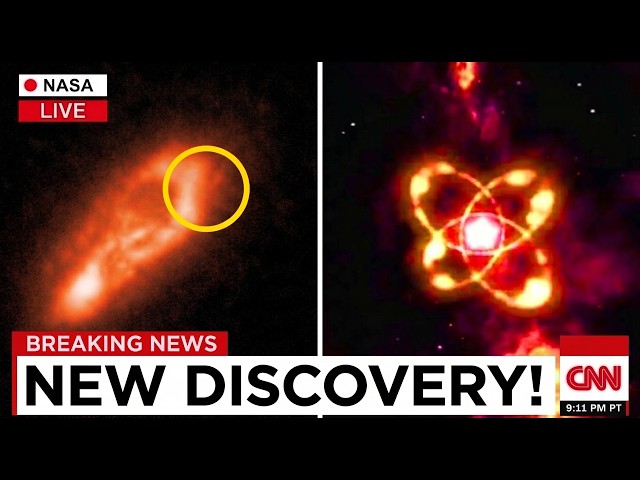
The accompanying thumbnail depicts a strange glowing object with a symmetrical, atom-like structure surrounded by brilliant energy. Although visually dramatic, this image should not be interpreted as an authenticated James Webb photograph of an impossible cosmic machine or an object that disproves the Big Bang.
Actual Webb observations often require careful image processing, spectroscopy, and scientific interpretation before researchers can determine what distant structures represent.
What makes the discoveries genuinely exciting is that Webb is allowing scientists to investigate a period of cosmic history that was largely inaccessible before its launch.
Each newly confirmed early galaxy provides another opportunity to test theories of star formation, black hole growth, and the evolution of matter under extreme conditions.
Future observations may reveal that the first galaxies developed more rapidly, contained more complex chemistry, or hosted larger black holes than existing models originally predicted.
The Big Bang is not over, but James Webb is uncovering a universe whose earliest chapters may have been far more dramatic than scientists expected. The real mystery is not whether the universe began with a Big Bang, but how it transformed from a nearly uniform sea of primordial matter into a cosmos filled with brilliant galaxies and enormous black holes so astonishingly quickly.