2 MINUTES AGO: The Weirdest Things NASA Found on Space Rocks
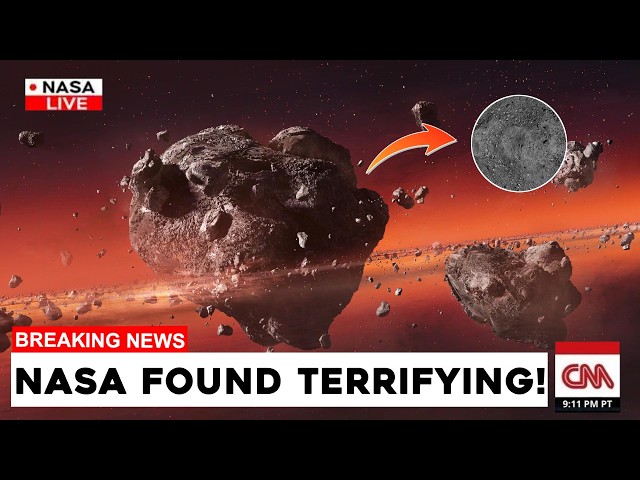
NASA’s exploration of asteroids has revealed that these seemingly ordinary space rocks can contain some of the most surprising materials ever recovered beyond Earth, offering scientists a rare glimpse into the chemistry that existed before our planet was born. While the dramatic image above depicts a chaotic asteroid field and suggests that NASA has just made a terrifying discovery, there is no evidence that the pictured scene represents an actual NASA observation or an immediate threat to Earth.
The genuine discoveries, however, are remarkable. One of the most important came from Bennu, the carbon-rich asteroid visited by NASA’s OSIRIS-REx spacecraft. After the spacecraft returned a sample of Bennu to Earth in September 2023, scientists began examining material that had remained largely unchanged for billions of years. NASA reported that analyses revealed carbon-rich compounds, hydrated minerals and evidence that Bennu’s ancient parent body once contained water.
Even more strikingly, researchers identified amino acids and all five nucleobases used by life on Earth to store and transmit genetic information. These findings do not mean scientists discovered extraterrestrial organisms. Instead, they demonstrate that important chemical ingredients associated with biology can form naturally in space and become incorporated into asteroids. Researchers also found salts and minerals suggesting that Bennu’s parent body once hosted pockets of salty liquid water.
That discovery raises fascinating questions about the chemical reactions that may have occurred inside primitive objects during the Solar System’s earliest history. Some scientists think asteroid impacts could have delivered water and organic molecules to the young Earth, potentially contributing raw materials to the environment in which life eventually emerged. Bennu is not the only asteroid producing surprises.
Samples from Ryugu, returned to Earth by Japan’s Hayabusa2 mission, have also contained organic compounds, including uracil—one of the nucleobases found in RNA—as well as vitamin B3. Together, Bennu and Ryugu provide scientists with pristine extraterrestrial material that has avoided much of the contamination and weathering experienced by meteorites after falling to Earth. Other asteroids are strange for entirely different reasons.
NASA’s Lucy spacecraft, for example, encountered the small asteroid Dinkinesh in 2023 and unexpectedly discovered that its tiny moon, Selam, is a contact binary—two lobes touching each other—giving scientists a rare opportunity to study how small bodies assemble in space. Meanwhile, NASA’s Psyche mission is traveling toward the metal-rich asteroid 16 Psyche, an object that could reveal information about the metallic building blocks involved in planetary formation.
None of these findings supports the idea that NASA has discovered a terrifying alien object hidden inside an asteroid, but the scientific reality may be even more compelling. Asteroids are effectively time capsules from the birth of the Solar System, preserving chemicals and minerals more than four billion years old. By studying them, scientists can reconstruct the conditions that existed before Earth became a habitable planet and investigate whether the ingredients necessary for life were widespread throughout the early Solar System.
Every sample returned to Earth therefore carries a message—not from an alien civilization, but from our own cosmic past—and researchers are only beginning to understand what these ancient rocks can tell us.


