James Webb Just Detected a Signal From Another Planet!
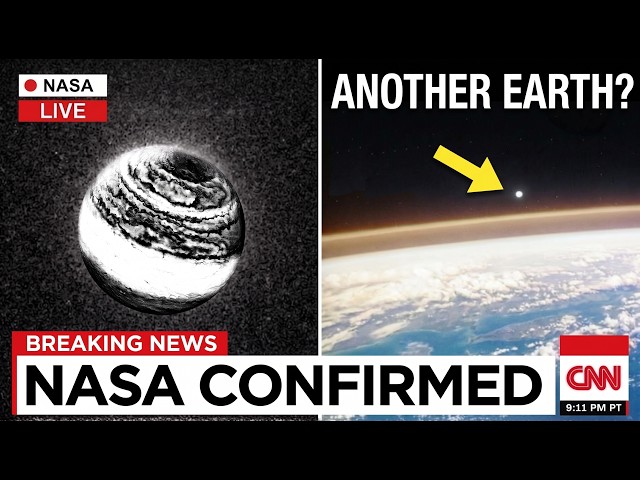
NASA’s James Webb Space Telescope is continuing to transform the study of planets beyond our Solar System, detecting extraordinarily faint signals that reveal what distant worlds are made of. But despite dramatic headlines suggesting that Webb has received a mysterious transmission—or perhaps even a message—from “another Earth,” there is currently no confirmed NASA announcement of an artificial or extraterrestrial communication signal. What Webb is detecting is something scientifically different but still remarkable: light carrying the chemical fingerprints of exoplanet atmospheres. When a planet passes in front of its host star, a tiny fraction of the starlight travels through the planet’s atmosphere before reaching Webb. Molecules absorb specific wavelengths, leaving patterns in the spectrum that astronomers can use almost like a chemical barcode. This technique has already allowed Webb to identify substances such as water vapor, methane and carbon dioxide on distant worlds. NASA Science One of the most intriguing targets is K2-18 b, located roughly 120 light-years away and orbiting a cool dwarf star within its habitable zone. Webb observations revealed methane and carbon dioxide in its atmosphere, while the relative shortage of ammonia is consistent with models in which a water ocean could exist beneath a hydrogen-rich atmosphere. However, that interpretation remains under investigation, and K2-18 b is substantially more massive than Earth—about 8.6 Earth masses—so describing it as a confirmed “Earth 2.0” would be misleading. NASA Science Webb has also demonstrated that these faint signals can reveal entirely new planets. In July 2026, NASA announced the discovery of Beta Pictoris d, a giant exoplanet in the nearby Beta Pictoris system. Remarkably, researchers identified the planet through the distinctive chemical fingerprint of its atmosphere rather than simply detecting it as a bright point of light. NASA said this approach could become an important new method for discovering and characterizing worlds around other stars. NASA Science Another remarkable case is WD 1856 b, a giant planet orbiting a white dwarf—the dense remnant left after a star dies. Webb measured the planet’s temperature and detected methane in its atmosphere, providing clues about how a planet could survive the violent evolution of its host star and later migrate into an extremely close orbit. NASA Science Scientists are particularly excited about applying these techniques to smaller rocky planets because atmospheric molecules could eventually help researchers evaluate whether a world might have conditions suitable for life. Yet an atmospheric chemical signal is not the same thing as evidence of biology, and it certainly is not proof of an intelligent civilization. Even molecules associated with life on Earth can sometimes be produced through non-biological chemistry, meaning multiple independent observations would be necessary before scientists could make an extraordinary claim. The planet-like object and “ANOTHER EARTH?” message shown in the accompanying image should therefore be viewed as an illustrative, sensational presentation rather than documentation of a NASA-confirmed second Earth. The real breakthrough is arguably just as profound: Webb has become sensitive enough to analyze light that has interacted with atmospheres on worlds trillions of kilometers away. Each faint spectral signal gives astronomers another piece of information about those planets—their temperatures, atmospheric chemistry, clouds and possible environments. We have not received a message from another civilization, but for the first time in human history, we are beginning to remotely investigate distant planetary atmospheres in extraordinary detail—and one day, one of those chemical fingerprints could lead us toward the answer to an even bigger question: Are we alone?