NASA’s Artemis Mission Just Revealed a Hidden Lunar Secret

NASA’s Artemis program is drawing renewed attention to a hidden feature of the Moon that could reshape the future of human exploration: significant deposits of water ice may be preserved inside permanently shadowed craters near the lunar south pole.
Unlike the equatorial regions visited by Apollo astronauts, this rugged polar landscape contains deep depressions that have received little or no direct sunlight for billions of years.
Temperatures inside some of these natural cold traps can plunge below minus 200 degrees Celsius, allowing water and other volatile substances delivered by ancient comets, asteroids or chemical reactions to remain frozen in the soil.
Data collected by NASA’s Lunar Reconnaissance Orbiter and other missions indicate that ice may be distributed across a much wider area than scientists once believed, although its concentration and accessibility vary considerably from one location to another. This frozen material is one reason Artemis planners have focused on the south polar region.
Water could provide drinking supplies for astronauts, while its hydrogen and oxygen components might eventually be separated to produce breathable air and rocket propellant.
Such resources would reduce the amount of material that future missions must transport from Earth, making longer expeditions and a sustained lunar presence more practical. But the ice is valuable for science as well as survival.
Samples could preserve a record of material deposited throughout the solar system’s history, potentially revealing how water reached Earth and other rocky worlds.
NASA has identified several candidate landing regions near the south pole, balancing their scientific importance against hazards such as steep slopes, rough terrain, extreme temperatures and rapidly changing illumination.
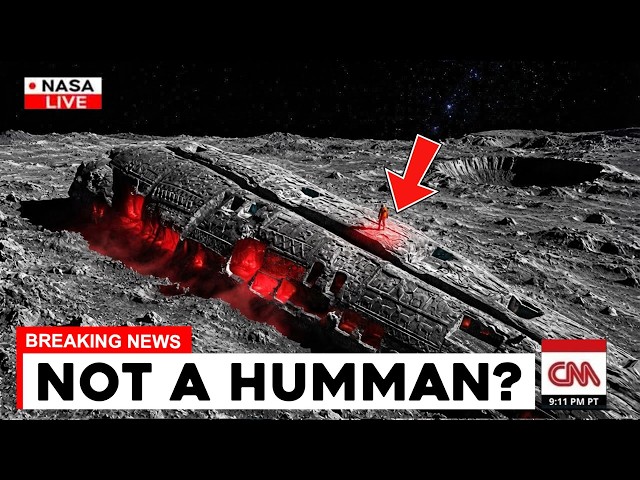
The dramatic object or illuminated structure presented in some online thumbnails should not be interpreted as a real discovery made on the lunar surface; such imagery is generally artistic and does not show an alien building, buried machine or mysterious artificial entrance.
The genuine “secret” is subtler but far more consequential: the apparently dry Moon may contain stores of ancient ice capable of supporting exploration and answering fundamental questions about planetary evolution.
Artemis astronauts and robotic missions will use specialized instruments to examine lunar soil, map underground layers and search for chemical signatures associated with water.
A neutron spectrometer, for example, can identify hydrogen-rich areas by measuring how cosmic radiation interacts with the surface, helping researchers determine where ice might be concentrated.
Scientists caution that detecting hydrogen does not automatically prove that easily recoverable blocks of pure ice are present. Some water may exist as scattered molecules, thin frost or grains mixed tightly with rock and dust. Direct sampling will therefore be essential.
If substantial deposits are confirmed, the discovery could turn the lunar south pole into both a scientific archive and a crucial stepping-stone toward Mars.
Artemis is not revealing evidence of extraterrestrial technology; it is exposing something with genuine power to change spaceflight—a hidden reservoir that may help humans live and work beyond Earth.