What James Webb Just Found on Neptune Has Scientists Confused!
NASA’s James Webb Space Telescope has captured Neptune’s auroras for the first time, revealing a phenomenon that looks—and behaves—very differently from the polar lights familiar on Earth. The breakthrough came from observations collected with Webb’s Near-Infrared Spectrograph in June 2023 and publicly announced by NASA in March 2025.
Scientists had suspected that auroras occurred on Neptune because NASA’s Voyager 2 spacecraft detected indirect hints during its historic 1989 flyby, yet decades of observations with other telescopes failed to produce a clear image or definitive infrared signature.
Webb finally succeeded by detecting a prominent emission from the trihydrogen ion, or H₃⁺, a charged molecule created when energetic particles collide with hydrogen in a planet’s upper atmosphere.
In processed Webb images, this activity appears as glowing cyan patches, providing the long-awaited confirmation that the solar system’s most distant giant planet possesses active auroras. What initially confused researchers was their location.
On Earth, auroral displays gather around the north and south geographic poles because the magnetic field is aligned relatively closely with the planet’s rotational axis. Neptune’s lights instead appear at middle latitudes—comparable to the latitude of South America on Earth.
The explanation lies in Neptune’s exceptionally strange magnetic field, which is tilted approximately 47 degrees from its rotation axis and significantly offset from the planet’s center.
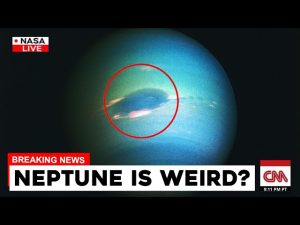
Charged particles therefore enter the atmosphere far from the conventional polar regions, producing glowing structures in places that might appear visually impossible. The dark feature highlighted in the accompanying thumbnail should not be interpreted as a spacecraft, opening or solid object.
The graphic has been heavily edited for dramatic effect, while genuine Webb observations combine infrared measurements with assigned colors to make otherwise invisible emissions understandable to the human eye.
Even more surprising than the auroras was Webb’s measurement of Neptune’s upper atmosphere. Researchers found that it had cooled by several hundred degrees since Voyager 2 visited, with its 2023 temperature measuring only slightly more than half the value recorded in 1989.
A colder atmosphere produces weaker infrared auroral emissions, which may explain why astronomers struggled for so long to detect them from Earth.
However, the scale of the cooling remains an important puzzle because Neptune orbits more than 30 times farther from the Sun than Earth and experiences seasons lasting roughly four decades.
Scientists do not yet fully understand how solar activity, atmospheric circulation and Neptune’s unusual magnetosphere combine to generate such substantial changes. Webb’s findings have therefore opened a new field of study rather than revealed anything threatening.
Astronomers hope to monitor Neptune across the Sun’s approximately 11-year activity cycle, tracking how the auroras respond to changes in the solar wind and whether the upper atmosphere continues to cool or begins warming again.
These observations could also clarify why Neptune’s magnetic field is so severely tilted and help engineers design instruments for future missions to the ice giants. Webb has not found an artificial object on Neptune—but it has revealed an alien-looking magnetic environment whose behavior is stranger and more dynamic than scientists anticipated.