NASA Just Calculated Mercury’s Metal Core Is Worth 3 Octillion Dollars

A staggering claim circulating online suggests that Mercury’s enormous metallic core could be worth as much as three octillion dollars if its contents were valued at current terrestrial commodity prices, but planetary scientists caution that the figure is a speculative thought experiment—not an official NASA appraisal or a realistic measure of extractable wealth. Mercury is the smallest planet in the solar system, yet it possesses an unusually large iron-rich core that extends through approximately 85 percent of the planet’s radius.
By comparison, Earth’s core occupies only a little more than half of its radius. Data from NASA’s MESSENGER spacecraft, which orbited Mercury from 2011 until 2015, revealed that the planet’s internal structure is more complicated than a simple solid ball of iron. Scientists believe it contains a solid inner core surrounded by a liquid metallic outer layer, with additional sulfur and other lighter elements mixed into the iron. That electrically conducting liquid helps generate Mercury’s weak but measurable global magnetic field—the only substantial magnetic field produced by a rocky planet besides Earth.
Converting this immense quantity of metal into a dollar value can generate numbers beyond ordinary economic comprehension. An octillion in the short numbering system is one followed by 27 zeros, so a three-octillion-dollar estimate would dwarf the total value of every company, resource and manufactured object on Earth. However, such calculations usually multiply a guessed mass of iron or other metals by present-day market prices while ignoring extraction expenses, technological limitations, transportation and the collapse in prices that would occur if enormous new supplies entered the market.
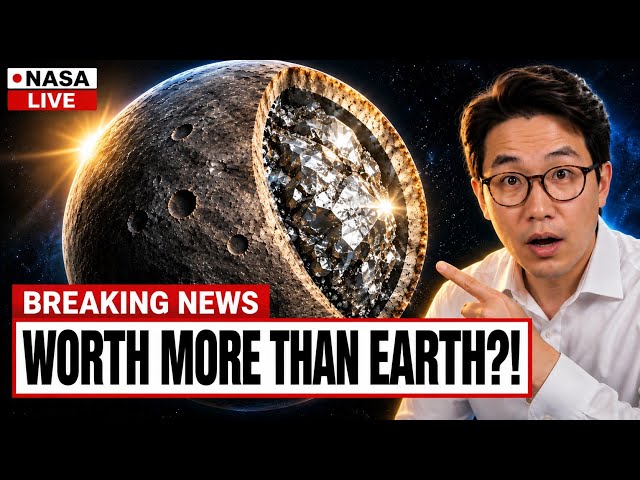
Mercury is also one of the least accessible places in the solar system. A spacecraft must lose tremendous orbital energy to approach the Sun, survive intense radiation and operate in surface temperatures that can exceed 430 degrees Celsius during the day. Mining material from deep inside the planet would require removing hundreds of kilometers of crust and mantle before lifting the metal away from Mercury’s powerful gravity and transporting it across interplanetary space. The thumbnail reinforces the extraordinary valuation with the phrase “Worth More Than Earth?!” Yet its depiction of Mercury sliced open to reveal giant sparkling gemstones is fictional artwork.
No mission has observed a diamond-filled cavity inside the planet, and scientists infer Mercury’s interior indirectly through gravity measurements, rotational motion, magnetic observations and laboratory models. The real scientific mystery is how Mercury acquired such an oversized core. One theory proposes that a massive impact stripped away much of an originally thicker rocky mantle, while another suggests that heat or chemical conditions near the young Sun prevented lighter material from accumulating.
Future observations by the European–Japanese BepiColombo mission may help distinguish between these possibilities. Mercury may contain a theoretically immense quantity of metal, but calling it a three-octillion-dollar treasure exaggerates what “value” means when the resource cannot be reached, recovered or sold. Its true worth lies in the clues it preserves about how rocky planets formed.