Google’s Quantum Computer Just Achieved the “IMPOSSIBLE”

Google’s Quantum AI team has announced a breakthrough that researchers say could mark a turning point in the race to build useful quantum computers, demonstrating a calculation that would be extraordinarily difficult for even the world’s most powerful conventional machines. The experiment was performed using Willow, Google’s 105-qubit superconducting processor, and a new method known as the Quantum Echoes algorithm.
According to Google, the system completed a specialized physics calculation approximately 13,000 times faster than one of today’s leading classical supercomputers, while producing a result that could be independently repeated and verified on another quantum processor. That last detail is especially significant: earlier demonstrations of “quantum advantage” were often criticized because the problems had little practical value or because checking the answers was nearly as difficult as calculating them.
Quantum Echoes works by disturbing a quantum system, precisely reversing its evolution and then measuring the resulting “echo,” allowing researchers to examine the hidden structure of molecules, materials and other complex systems. Google believes the technique could eventually improve nuclear magnetic resonance research and help scientists study new medicines, batteries, superconductors and materials at the atomic level. The result builds upon Willow’s earlier achievements. When Google introduced the chip in 2024, it reported that Willow had completed a random-circuit-sampling benchmark in less than five minutes—a task the company estimated would take a leading classical supercomputer around 10 septillion years.
More importantly, researchers demonstrated that certain errors could decline as they increased the size of an encoded quantum system, passing a crucial threshold on the long road toward fault-tolerant computing. Google now describes Quantum Echoes as the first demonstration of a verifiable quantum advantage on hardware, although independent researchers will continue testing the methodology, assumptions and classical comparisons behind that claim. The achievement does not mean quantum computers have replaced ordinary computers, broken modern encryption or suddenly become capable of solving every scientific mystery.
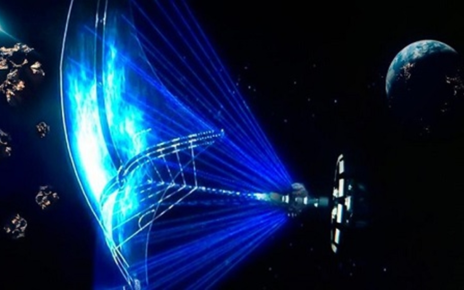
Willow remains an experimental machine whose fragile qubits must operate at extremely low temperatures, and useful fault-tolerant systems will require far more reliable logical qubits than current devices possess. The accompanying thumbnail, which carries the dramatic message “NASA SHOCKED,” uses imagery resembling an unexplained nighttime event rather than an authentic view of Google’s quantum processor. NASA did not announce this result, and the image should be treated as fictional promotional artwork, not documentary evidence. Nevertheless, the underlying development is genuinely important.
By moving beyond a deliberately artificial benchmark toward a repeatable experiment connected to real physical systems, Google has narrowed the distance between quantum computing as a laboratory spectacle and quantum computing as a scientific instrument. Researchers caution that years of engineering challenges remain, but the “impossible” achievement is not a machine defying physics—it is a machine exploiting quantum physics well enough to perform one carefully selected task at a speed classical technology cannot presently match.
Google Quantum AI describes the experiment as a step toward practical applications, while Google Research emphasizes that repeatability and verification distinguish it from previous demonstrations.