NASA Just Saw Uranus After 50 Years — And Something Is Wrong

GREENBELT, Maryland — Nearly four decades after Voyager 2 became the first—and so far only—spacecraft to visit Uranus, a new generation of observations has revealed that the distant ice giant is far more active and mysterious than the nearly featureless world scientists saw in 1986. Recent measurements from the James Webb Space Telescope have provided the first detailed vertical map of Uranus’s upper atmosphere, exposing unusual auroral bands, dramatic temperature variations, and evidence that the planet has continued cooling for more than 30 years.
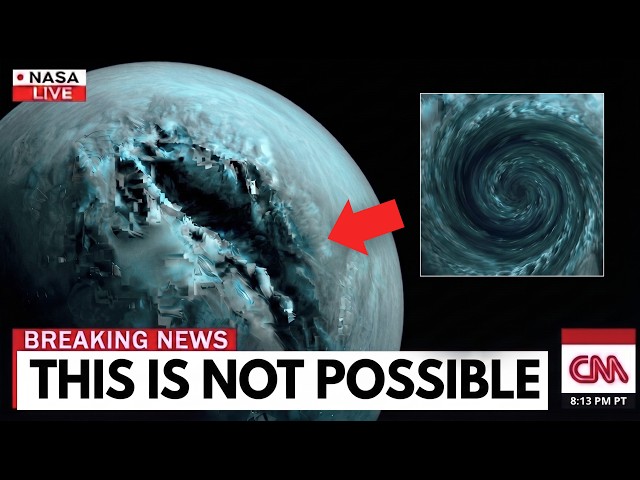
The results have generated excitement among planetary scientists, although NASA has not reported the enormous hole or destructive vortex portrayed in the accompanying viral image. That picture is a digitally altered illustration, not an authentic photograph from Voyager, Hubble, or Webb. What the telescopes have actually found is scientifically compelling enough without exaggeration. Uranus rotates almost completely on its side, with an axial tilt of about 98 degrees, likely the result of a gigantic collision early in the solar system’s history.
Its magnetic field is equally strange: the magnetic axis is sharply tilted relative to the planet’s rotation and does not pass cleanly through its center. As Uranus turns, its magnetosphere wobbles through space in a complex motion, producing auroras unlike those seen on Earth, Jupiter, or Saturn. Webb’s Near-Infrared Spectrograph observed the planet for nearly one complete rotation and mapped how charged particles and temperatures change at different altitudes. Researchers identified two bright auroral bands associated with Uranus’s displaced magnetic poles, separated by a region with lower emission.
The observations also confirmed that the planet’s upper atmosphere has been cooling since measurements began in the early 1990s, raising new questions about how Uranus gains, distributes, and loses energy. Scientists do not yet know whether this long-term decline is primarily seasonal, driven by changes in solar activity, or connected to circulation deep inside the atmosphere. Uranus requires 84 Earth years to orbit the Sun, so each season lasts approximately 21 years. Humanity has therefore observed the planet through only a limited portion of its seasonal cycle with modern instruments. Hubble and Webb have also documented a brightening polar cap, changing cloud formations, powerful winds, rings, and occasional storms that contradict the old image of Uranus as a calm blue-green sphere.
The dark central region shown in processed images may resemble a hole, but it is generally the product of atmospheric contrast, wavelength selection, and image enhancement—not a physical opening into the planet. According to NASA’s Uranus overview, the ice giant has 13 known rings and an atmosphere dominated by hydrogen, helium, and methane, while its interior probably contains a hot, dense mixture of water, methane, and ammonia above a rocky core. Nothing indicates that Uranus is breaking apart or threatening Earth.
The real concern is how little scientists still understand about it. With no dedicated spacecraft currently orbiting the planet, researchers must reconstruct its behavior from distant observations and the decades-old Voyager encounter. Something may indeed seem “wrong” with Uranus—but the new evidence suggests the problem lies not with the planet, but with humanity’s incomplete picture of one of the solar system’s strangest worlds.