3 MINUTES AGO: James Webb Just Captured the Unimaginable!
The James Webb Space Telescope has uncovered evidence of a supermassive black hole that may have formed before its surrounding galaxy, a discovery that challenges one of astronomy’s most familiar ideas about how the universe developed.
The object lies at the center of Abell2744-QSO1, an extremely small and distant galaxy whose light has traveled for more than 13 billion years to reach Earth.
By combining Webb’s infrared imaging with detailed spectroscopy, researchers mapped the composition and movement of gas racing around the galaxy’s core and calculated that its black hole contains roughly 50 million times the mass of the Sun.
The astonishing part is the imbalance: the black hole appears far too massive compared with the young galaxy surrounding it. In the nearby universe, supermassive black holes and their host galaxies generally follow a recognizable relationship, suggesting that they grow together over billions of years.
Abell2744-QSO1 appears to reverse that order. Its black hole may have been enormous from the beginning and could now be helping to construct the galaxy around itself.
One explanation is that the object began as a “heavy seed” created through the direct collapse of a gigantic primordial gas cloud. A more radical possibility explored by researchers is that some black-hole seeds originated through exotic physical processes during the universe’s earliest moments, potentially within the first second after the Big Bang.
Neither scenario means the laws of physics have failed, but both would require scientists to rethink how quickly enormous cosmic structures could emerge.
Webb has also identified another rapidly growing supermassive black hole in CANUCS-LRD-z8.6, a compact galaxy seen only about 570 million years after the Big Bang.
Its black hole is likewise unusually massive for its host, suggesting that Abell2744-QSO1 may belong to a broader population of early systems in which black holes developed before galaxies reached maturity.
These findings may help explain the mysterious “little red dots” discovered throughout Webb’s deep observations—tiny, intensely red objects that appear surprisingly common in the early universe and may contain actively feeding black holes hidden by dense gas and dust.
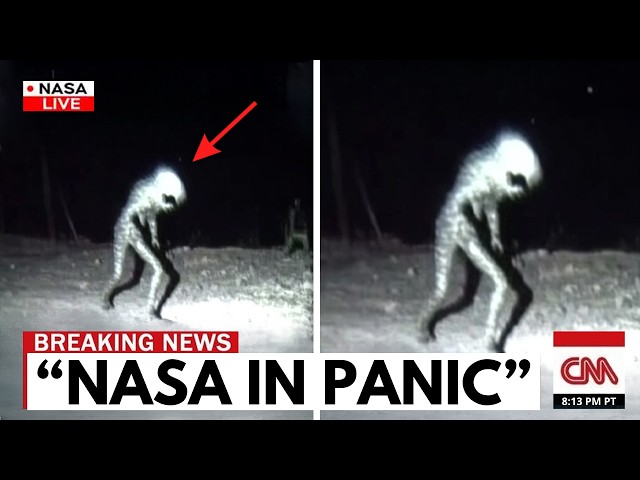
Despite the accompanying viral thumbnail, Webb has not photographed a humanoid creature walking through a forest, and NASA has issued no emergency announcement about extraterrestrial life.
The image is unrelated to astronomical data and should be treated as staged or digitally manipulated material. Webb cannot produce surveillance-style photographs of beings on distant planets; most remote galaxies appear as compact smudges or points of light, with their physical properties reconstructed from spectra.
The phrase “three minutes ago” is also a dramatic headline rather than the verified time of a NASA release. What Webb genuinely captured is unimaginable enough: an object millions of times more massive than the Sun existing when the universe was still in its infancy, apparently outgrowing—or even preceding—the galaxy meant to contain it.
The discovery does not reveal an alien visitor, but it exposes a universe capable of building monsters far sooner than astronomers once believed possible.