The James Webb Space Telescope has revealed a previously hidden planet inside one of the most intensively studied star systems in our galactic neighborhood, demonstrating that entire worlds can remain concealed even after decades of observation.

The newly identified exoplanet, named Beta Pictoris d, orbits Beta Pictoris, a young star located approximately 63 light-years from Earth. Astronomers already knew that the system contained two enormous planets, Beta Pictoris b and Beta Pictoris c, as well as a bright disk of dust and debris left over from its formation.
Researchers were not searching for another planet when they directed Webb’s Near-Infrared Spectrograph toward Beta Pictoris b to analyze its atmosphere. Instead, they noticed an unexpected signal in a region where ordinary reflected light from dust should have produced a relatively smooth spectrum.
The signal contained a distinctive pattern of carbon-monoxide absorption lines—a chemical “barcode” associated with the atmosphere of a giant planet. By measuring both the chemical fingerprint and the object’s movement, the team determined that it was orbiting Beta Pictoris rather than being a distant background star, an image-processing artifact, or a brown dwarf passing behind the system.
Follow-up observations using Webb’s Mid-Infrared Instrument detected methane and water vapor, providing additional confirmation that the hidden source was a planet. Beta Pictoris d is estimated to have at least twice the mass of Jupiter and to orbit its star at roughly 30 times the Earth-Sun distance, placing it in a region comparable to Neptune’s orbit in our solar system.
The discovery makes Beta Pictoris only the second known planetary system in which astronomers have directly identified at least three planets through imaging-related techniques. What makes the achievement especially important is how the planet was found.
The system’s debris disk scatters so much starlight that conventional images struggle to separate faint planets from surrounding dust. Webb effectively looked through that cosmic fog by isolating atmospheric molecules instead of relying solely on a recognizable point of light.
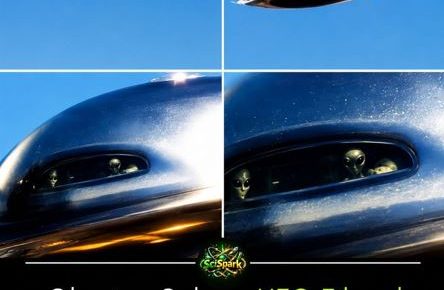
Scientists believe the gravity of Beta Pictoris d may help explain the debris disk’s sharply defined inner edge and other structures that had previously suggested an unseen planet was present. However, the enormous metallic object displayed in the accompanying viral thumbnail is not an authentic Webb photograph.
NASA has not detected an alien spacecraft, issued an emergency warning, or announced that Earth is in danger. Webb’s real reconstructed image shows faint sources and scientific markings, while detailed views of the planet are artists’ concepts based on measured data.
The phrase “one minute ago” should also be understood as dramatic presentation rather than the timing of an official scientific release. What has genuinely stopped astronomers in their tracks is the realization that a massive planet could remain hidden inside such a famous and closely examined system.
The discovery introduces a powerful new method for finding worlds in dusty environments: identifying them through the chemistry of their atmospheres. Webb has not captured an extraterrestrial vessel approaching Earth—it has shown that planetary systems can contain major worlds invisible to traditional searches, and that some of the universe’s most significant discoveries may already be concealed inside data scientists thought they understood.