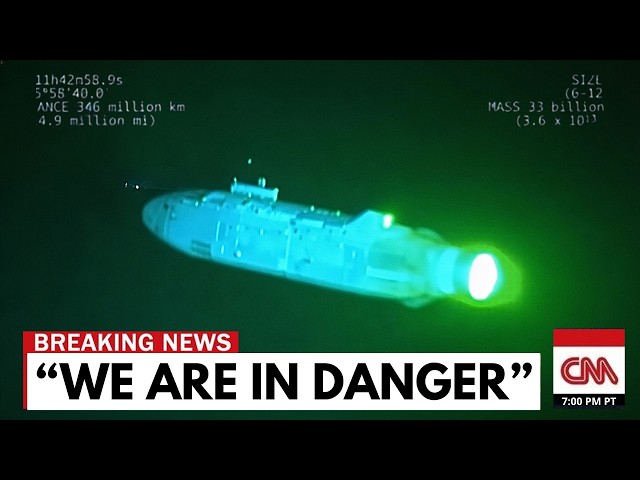
A mysterious set of numbers allegedly transmitted by NASA’s Voyager 1 has triggered dramatic online claims that humanity’s most distant spacecraft has identified an unknown object in interstellar space, but the reality behind the signal is both less threatening and more scientifically fascinating.

According to viral reports, the supposed coordinates point toward a gigantic artificial structure traveling beyond the edge of the solar system, leading some commentators to suggest that Voyager may have encountered evidence of an extraterrestrial civilization. The image accompanying these claims appears to show a long metallic spacecraft surrounded by green light, together with estimated coordinates, dimensions, and mass. However, NASA has issued no announcement confirming that Voyager 1 transmitted coordinates to such an object, and the spacecraft is physically incapable of taking the photograph shown in the sensational thumbnail. Voyager 1’s wide-angle and narrow-angle cameras were permanently switched off in February 1990 after it completed the famous “Solar System Family Portrait.” The camera-control software was later removed from the spacecraft’s computers to conserve limited memory and power for instruments designed to study interstellar particles, plasma waves, and magnetic fields. Nearly 49 years after its 1977 launch, Voyager 1 continues to communicate with Earth from more than 25 billion kilometers away, but its surviving instruments do not search space like radar or produce navigational images of nearby objects. Its magnetometer measures changes in magnetic fields, while its plasma-wave subsystem detects oscillations in the thin ionized gas surrounding the spacecraft.
These instruments can reveal shock waves, variations in plasma density, and disturbances caused by solar activity traveling far beyond the heliosphere. Such measurements sometimes appear as unusual patterns in raw scientific data, but they are not encrypted maps or coordinates supplied by an unknown intelligence. Mission controllers also regularly transmit and receive navigation information describing Voyager 1’s position, direction, and orientation. When those technical values are removed from context, they can easily be misrepresented as coordinates to a mysterious discovery. The probe’s extreme distance makes every transmission remarkable: a one-way radio message takes almost 24 hours to cross the space between Voyager and Earth, and the signal reaching NASA’s Deep Space Network is incredibly faint. According to NASA’s current mission information, Voyager 1 remains active with only two science instruments operating as engineers progressively shut down equipment to compensate for its declining nuclear power supply. The genuine danger is therefore not an approaching alien vessel, but the possibility that communication with one of humanity’s greatest explorers could end within the coming years. Voyager 1 is losing approximately four watts of available electrical power annually, leaving engineers with increasingly difficult decisions about which systems can remain active. Eventually, the spacecraft will become too weak to collect data or maintain contact with Earth. Until then, every faint signal will be carefully examined for information about the interstellar environment. Voyager 1 has not directed humanity toward a hidden spacecraft, nor has it warned that Earth is in danger. What it has done is send back measurements from a region no other active mission has reached—reminding us that the real universe is already mysterious enough without turning scientific telemetry into evidence of an alien encounter.