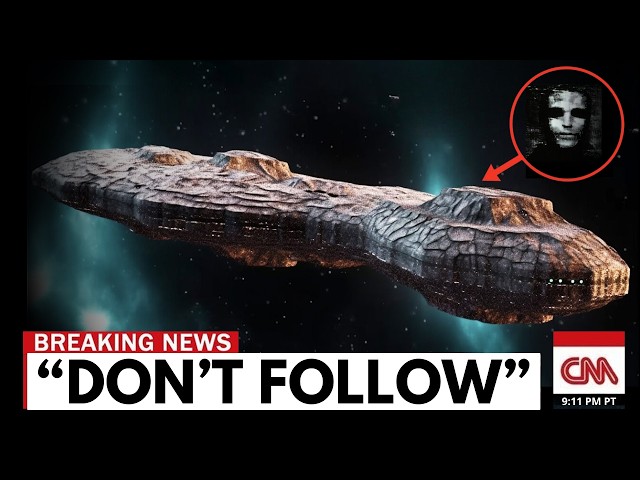
Voyager 1’s Final Transmission CONFIRMS WHAT WE ALL FEARED!
A faint radio signal traveling across billions of miles of interstellar darkness has once again focused the world’s attention on Voyager 1, humanity’s most distant spacecraft, but despite the dramatic claims circulating online, the probe has not photographed an alien vessel, broadcast a warning telling Earth “don’t follow,” or delivered evidence of a hostile intelligence waiting beyond the solar system.

The unsettling truth revealed by Voyager 1’s latest chapter is less sensational, yet far more real: after nearly five decades in space, the legendary explorer is slowly running out of electrical power, and every message received from it could now be among the last. Launched by NASA on September 5, 1977, Voyager 1 was originally designed for a mission lasting only a few years, during which it conducted historic flybys of Jupiter and Saturn, discovered previously unknown moons and rings, and transformed scientists’ understanding of the outer planets. Instead of failing after completing those assignments, the spacecraft continued outward, crossed the heliopause in 2012, and became the first human-made object to enter interstellar space—the region beyond the protective bubble of particles and magnetic fields produced by the Sun. Voyager 1 is now more than 25 billion kilometers from Earth, so distant that its radio transmissions require almost an entire day to reach the antennas of NASA’s Deep Space Network.
The signal arriving at Earth is extraordinarily weak, and communicating with the probe demands enormous ground-based antennas, precise calculations, and equipment capable of detecting a whisper from the edge of humanity’s technological reach. That fragile link has survived computer failures, clogged thruster systems, communication interruptions, and the steady decline of the spacecraft’s nuclear power supply, but it cannot survive forever. Voyager 1 receives electricity from radioisotope thermoelectric generators that convert heat released by decaying plutonium-238 into power. As the radioactive material naturally decays and the generators age, the spacecraft loses roughly four watts of available power every year. Mission engineers have responded by switching off heaters, instruments, and other systems one at a time, carefully balancing scientific value against the basic need to keep the spacecraft alive. In February 2025, the team shut down Voyager 1’s cosmic-ray subsystem, and in April 2026 it turned off the low-energy charged-particle experiment, an instrument that had operated almost continuously since launch. Only the magnetometer and plasma-wave subsystem remain listed as active science instruments aboard Voyager 1, according to NASA’s current mission-status page. These shutdowns do not point to alien interference or an approaching cosmic object; they confirm what engineers have anticipated for years—that Voyager 1 has entered the final, power-starved phase of its extraordinary life. The spacecraft’s vulnerability became especially clear in November 2023, when it stopped returning readable scientific and engineering information. Controllers could tell that Voyager 1 was still receiving commands, but the data sent back to Earth had become an unintelligible stream. After months of investigation, engineers traced the problem to a failed memory chip in the flight data subsystem, one of the probe’s three onboard computers. Because no single remaining section of memory was large enough to hold the lost software, the team divided the affected code and relocated it across several available areas—an astonishing repair performed remotely on technology built in the 1970s. Readable engineering information returned in April 2024, followed later by science data, but another scare came when a fault-protection response shut down Voyager 1’s main X-band radio transmitter and activated a much weaker backup transmitter that had not been used since 1981. NASA eventually restored regular operations, demonstrating once again the resilience of both the spacecraft and the engineers responsible for it. Yet each successful recovery also underlines how little margin remains. Components cannot be replaced, the onboard computers possess only a tiny fraction of the processing power found in a modern phone, commands take many hours to arrive, and confirmation of any result takes many more. Even the thrusters used to keep Voyager 1’s antenna pointed toward Earth have developed problems as aging fuel tubes accumulate residue, forcing engineers to alternate among different thruster systems and revive hardware once considered unusable. The eerie spacecraft shown in viral thumbnails—often accompanied by a distorted face, a red arrow, or a warning such as “DON’T FOLLOW”—is therefore best understood as digital artwork designed to provoke curiosity, not as an authentic Voyager photograph. Voyager 1’s cameras were permanently switched off in February 1990 after the probe captured its famous “Solar System Family Portrait,” which included the image of Earth known as the “Pale Blue Dot.” The spacecraft cannot secretly send back modern photographs of alien ships because its imaging system has been inactive for more than 36 years. What it continues to transmit is far less cinematic but scientifically invaluable: measurements of magnetic fields, plasma waves, and conditions in a region no operating spacecraft had reached before the Voyager probes. Those signals help researchers study how the Sun’s influence interacts with the interstellar environment and reveal a frontier that cannot yet be examined by any newer mission. NASA estimates that engineering signals might remain detectable by the Deep Space Network into the 2030s, although useful scientific observations are likely to end earlier as the remaining instruments are shut down to conserve power. Eventually, Voyager 1 will lose the ability to operate its instruments, maintain its orientation, or generate a radio signal strong enough for Earth to hear. There may be no dramatic final sentence, no alien warning, and no cinematic countdown. The end could come as a gradually weakening carrier signal, an unexplained technical failure, or a routine transmission that simply is not followed by another. When silence finally arrives, it will confirm the fear that truly matters—not that Voyager discovered something monstrous in the dark, but that humanity is about to lose contact with one of its greatest explorers. The spacecraft itself will continue traveling through the Milky Way long after its power is gone, carrying its Golden Record of sounds, music, greetings, and images from Earth as a silent artifact of the civilization that created it. In roughly 40,000 years, it will pass within about 1.6 light-years of another star, but there is no guarantee that anyone—or anything—will ever find it. Voyager 1’s genuine final transmission, whenever it comes, will not prove that we are being watched. It will remind us that even our most durable machines are temporary, that communication across interstellar distances is astonishingly difficult, and that a spacecraft built with 1970s technology managed to keep speaking to Earth for nearly half a century. That reality may not resemble the ominous alien vessel pictured in sensational online artwork, but it is more profound: at the edge of the Sun’s fading influence, Voyager 1 is still carrying a trace of humanity into the unknown, while Earth listens carefully for every remaining whisper.