Viral Theory Suggesting Aliens Are Future Humans Sparks Renewed Debate Across Social Media
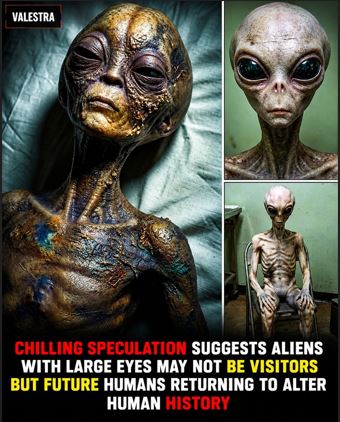
A striking collection of images circulating widely on social media has reignited one of the most fascinating theories in the world of UFO speculation: the idea that the mysterious beings commonly described as “Greys” may not be extraterrestrial visitors from distant star systems, but instead evolved humans traveling backward through time. The viral post, featuring humanoid figures with oversized black eyes, elongated skulls, and extremely slender bodies, has attracted millions of views while fueling intense discussion among UFO enthusiasts, futurists, and scientists alike.

The images are accompanied by the bold claim that these alleged alien beings could represent humanity’s own distant descendants returning to alter—or perhaps observe—the timeline of human history. Although the theory has existed for decades in fringe scientific and paranormal circles, renewed interest has emerged as advances in artificial intelligence, quantum physics, and theoretical discussions about time travel continue to capture the public imagination.
According to supporters of the hypothesis, the anatomy of the so-called Grey aliens appears remarkably consistent with predictions about how humans might evolve thousands or even millions of years into the future. They point to the creatures’ enlarged craniums, suggesting that continued technological advancement could eventually favor larger brains capable of processing enormous amounts of information. Their thin bodies are interpreted as the result of a future lifestyle requiring little physical labor, while the oversized eyes are theorized to be adaptations for living in environments with limited natural sunlight, such as underground cities, artificial habitats, or distant planets.
The viral images have prompted thousands of online discussions, with many users arguing that the similarities between alleged alien descriptions and speculative models of future human evolution are too striking to ignore. Others believe the idea provides a possible explanation for why reported encounters often involve beings with unmistakably human characteristics rather than completely unfamiliar biological forms.
Some supporters also reference reports of alleged alien abduction experiences, noting that many witnesses describe medical examinations focusing on genetics, reproduction, and DNA sampling. Within the framework of the future-human hypothesis, these alleged activities are interpreted not as hostile experiments but as scientific research conducted by descendants attempting to understand or preserve their own evolutionary history.
The theory has occasionally been discussed by a small number of researchers and science fiction authors who speculate about the long-term consequences of human evolution. They argue that advances in genetic engineering, artificial intelligence, cybernetic enhancement, and biotechnology could dramatically reshape the human body over thousands of generations. If such descendants eventually mastered technologies capable of manipulating space-time, proponents suggest they might visit earlier periods of history for observation or research.
However, scientists emphasize that no evidence currently supports the existence of human time travelers or confirms that reported alien encounters involve future descendants of humanity. While theoretical physics permits mathematical discussions of phenomena such as wormholes and space-time curvature, transforming those concepts into practical time travel remains entirely speculative.
Physicists point out that Einstein’s theory of general relativity allows time to pass at different rates under certain conditions, such as traveling at extremely high speeds or experiencing intense gravitational fields. These well-established effects have been experimentally confirmed through precision measurements involving satellites and atomic clocks. Yet traveling backward through time introduces numerous unresolved paradoxes and remains one of the most controversial topics in theoretical physics.
Among the best-known challenges is the so-called “grandfather paradox,” which questions how a traveler could alter events that ultimately led to their own existence. Various speculative solutions—including branching timelines, parallel universes, and self-consistent histories—have been proposed by physicists, but none have been experimentally demonstrated.
Biologists are equally cautious regarding the evolutionary arguments presented in the viral posts. Human evolution does not follow predetermined pathways, and predicting the appearance of humans tens of thousands of years into the future is highly uncertain. Environmental conditions, technological developments, cultural changes, and genetic engineering could influence evolution in countless unpredictable ways.
Meanwhile, psychologists suggest that the popularity of the future-human theory reflects a broader fascination with humanity’s destiny rather than evidence supporting its validity. Unlike traditional extraterrestrial hypotheses, the idea that aliens are our descendants creates a narrative connecting humanity’s past, present, and future into a single continuous story. This concept resonates strongly with audiences interested in science fiction, cosmology, and philosophical questions about civilization’s long-term survival.
The widespread sharing of AI-generated artwork has further amplified these discussions. Advances in image-generation technology now enable artists to create remarkably realistic depictions of humanoid beings based on popular descriptions found in UFO literature. While visually compelling, such illustrations should not be interpreted as documentary evidence or authentic photographs.
Experts in digital media caution that viral images frequently circulate without context, making it difficult for viewers to distinguish artistic renderings from verified documentation. As artificial intelligence becomes increasingly capable of producing photorealistic imagery, critical evaluation of online content has become more important than ever.
Despite the lack of empirical evidence, the future-human hypothesis continues to inspire debate because it combines elements of evolutionary biology, theoretical physics, and speculative futurism into a single thought-provoking narrative. For some, it offers an imaginative alternative to the traditional belief that unidentified beings originate from distant planets. For others, it remains an entertaining science-fiction concept unsupported by scientific observation.
At present, there is no verified evidence demonstrating that alleged Grey aliens are future humans, extraterrestrial visitors, or any other non-human intelligence. The viral images and accompanying claims remain speculative interpretations rather than established fact. Nevertheless, the discussion illustrates humanity’s enduring curiosity about both our cosmic neighbors and our own distant future. As research into astronomy, genetics, artificial intelligence, and physics continues to advance, questions about humanity’s place in the universe will likely remain among the most compelling mysteries of modern science—even if definitive answers remain elusive.