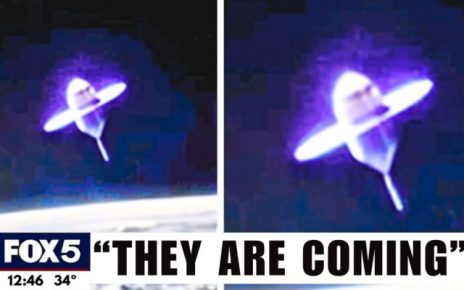
Mysterious Starfish-Shaped Object Spotted Off Natuna Waters Sparks New Debate Over Unidentified Ocean Phenomena
A series of striking images allegedly captured over the waters near Indonesia’s Natuna Islands has ignited widespread discussion across social media after appearing to show a bizarre starfish-shaped object emerging from the ocean. The unusual sighting, which quickly spread through UFO and unexplained phenomena communities, has prompted renewed speculation about unidentified objects operating beneath Earth’s oceans and the possibility that unexplained aerial phenomena may not be limited to the skies.

The photographs, shared by several online accounts specializing in unexplained mysteries, depict what appears to be a massive multi-armed object breaking through the ocean surface. Unlike the classic disc-shaped flying saucers frequently associated with UFO reports, this object resembles an enormous metallic sea star, with long pointed extensions radiating outward from a central body. Witnesses who reposted the images claimed the object surfaced only briefly before disappearing beneath the waves, leaving behind turbulent water and a trail of unanswered questions.
According to online reports accompanying the viral images, the alleged incident occurred near the Natuna Islands, a remote archipelago located in the South China Sea. The region is known for its strategic location, rich marine biodiversity, and frequent commercial and military maritime activity. Because thousands of vessels travel through these waters each year, unusual sightings often attract significant public attention.
Within hours of the photographs appearing online, thousands of users began debating what exactly had been captured. Some viewers argued that the object displayed structural symmetry inconsistent with any known marine animal, suggesting it could represent an advanced underwater craft built by an unknown civilization. Others proposed that it might be evidence supporting the long-discussed theory of USOs—Unidentified Submerged Objects—which some researchers believe may operate beneath the oceans before occasionally entering the atmosphere.
Supporters of the extraterrestrial hypothesis pointed to decades of eyewitness reports describing unidentified craft entering or exiting the sea without producing the splash or wake expected from conventional aircraft. They argue that if an advanced civilization were monitoring Earth, the world’s oceans would provide an ideal location for remaining hidden from human observation. Since more than seventy percent of Earth’s surface is covered by water, vast regions remain largely unexplored, fueling speculation about what may exist in the deep.
Several former military personnel and civilian witnesses have previously reported encounters involving unidentified objects traveling seamlessly between air and water. While many of these reports remain unexplained, none have produced definitive evidence confirming extraterrestrial technology. Nevertheless, the concept of transmedium vehicles—craft capable of operating in multiple environments—has become an increasingly discussed topic within modern UAP research.
Not everyone, however, is convinced that the Natuna images depict anything extraordinary.
Marine biologists who commented on similar viral photographs have noted that unusual viewing angles, powerful waves, floating debris, fishing equipment, or naturally occurring marine life can sometimes create optical illusions that appear highly unusual when captured in a single frame. Shadows, reflections, water spray, and digital compression may also distort the apparent size and shape of distant objects.
Digital imaging specialists likewise caution that photographs circulating on social media should be approached carefully unless their original source files can be independently verified. Modern editing software and artificial intelligence image-generation tools are capable of producing highly convincing scenes that closely imitate real photography. Without access to the original image metadata, camera information, location details, or multiple verified viewpoints, determining authenticity becomes extremely difficult.
The viral images have nevertheless revived discussion surrounding unidentified underwater phenomena, a subject that has received increasing attention over the past several years. Government agencies investigating Unidentified Anomalous Phenomena have acknowledged receiving reports involving objects that appear capable of unusual movement near bodies of water. However, officials have emphasized that unexplained observations should not automatically be interpreted as evidence of extraterrestrial technology.
Scientists also point out that Earth’s oceans remain one of the least explored environments on the planet. Despite centuries of maritime exploration, researchers estimate that a significant portion of the deep ocean has never been directly observed by humans. This lack of knowledge naturally encourages speculation whenever unusual imagery emerges from remote marine locations.
Online communities have proposed numerous alternative explanations for the Natuna object. Some believe it could be an experimental autonomous underwater vehicle developed for military or scientific research. Others suggest it may be an unusual offshore structure viewed from an unexpected perspective. More skeptical observers argue that the entire image may simply be computer-generated artwork designed to attract attention on social media.
As interest continued to grow, users began enhancing and analyzing the photographs frame by frame, measuring the apparent symmetry of the object’s extended arms and examining the surrounding water for signs of digital manipulation. While some claimed the analysis supported authenticity, others concluded that the available images were too compressed to allow meaningful forensic examination.
At present, no government authority, maritime agency, scientific institution, or independent investigative organization has publicly verified the authenticity of the photographs or confirmed that an unidentified object surfaced near the Natuna Islands. Likewise, no radar records, satellite imagery, or eyewitness testimony from identifiable sources has been released to corroborate the viral claims.
Even without confirmation, the mysterious images have once again demonstrated the enduring fascination surrounding unexplained phenomena in Earth’s oceans. Whether the object ultimately proves to be an unusual natural occurrence, an advanced piece of human technology, a digital fabrication, or something that remains unidentified, the viral photographs have reignited public curiosity about what may still lie hidden beneath the vast and largely unexplored depths of the world’s oceans.
For now, the “starfish-shaped UFO” remains exactly that—an intriguing mystery whose true nature continues to inspire speculation, skepticism, and a renewed interest in one of the planet’s final frontiers.