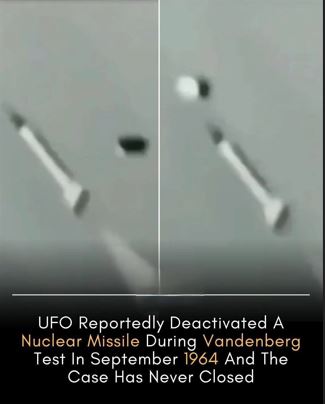
The 1964 Vandenberg UFO Incident Returns to the Spotlight as Researchers Revisit One of History’s Most Controversial Military Claims
A decades-old story involving an alleged unidentified flying object interfering with a U.S. missile test has once again captured worldwide attention after renewed interest in declassified military documents and eyewitness testimony. The incident, commonly associated with Vandenberg Air Force Base in California, is one of the most debated cases in UFO history. Supporters believe it represents one of the strongest accounts of an unidentified object interacting with advanced military technology, while skeptics argue that the available evidence remains inconclusive and largely anecdotal.
The story traces its origins to September 1964, when the United States was conducting routine missile development and weapons testing during the height of the Cold War. According to accounts that emerged years later, a long-range missile carrying a dummy nuclear warhead was launched as part of a scheduled evaluation. Military cameras positioned hundreds of miles away reportedly tracked the missile throughout its flight, recording every stage of the test.
What allegedly happened next has fueled speculation for more than half a century.
According to former Air Force officer Dr. Robert Jacobs, who has spoken publicly about the event for decades, one of the high-speed tracking cameras captured footage of an unidentified disc-shaped object approaching the missile while it was traveling through the upper atmosphere. Jacobs has claimed that the object circled the missile several times before emitting several bright beams or flashes of light directed toward the warhead. Moments later, according to his account, the warhead reportedly lost control and fell away from its intended trajectory.
Jacobs has consistently stated that shortly after reviewing the film, he was instructed by senior military personnel never to discuss what he had witnessed. He later alleged that the footage was confiscated and classified, preventing further public examination.
The extraordinary story remained largely unknown until Jacobs began publicly discussing the incident years after leaving military service. Since then, his testimony has become one of the most frequently cited accounts in discussions involving unidentified aerial phenomena and alleged military encounters.
Adding to the mystery is testimony from the late Major Florenze J. Mansmann, who supervised the photographic instrumentation unit involved in missile testing. Before his death, Mansmann acknowledged that Jacobs had indeed been shown unusual footage following one missile launch. However, interpretations of exactly what appeared on the film have varied, and no original recording has ever been released publicly for independent scientific analysis.
Supporters argue that the consistency of Jacobs’ account over several decades lends credibility to the story. They point out that he has maintained essentially the same version of events through interviews, documentaries, and public lectures despite intense scrutiny from critics.
Some UFO researchers suggest that if the incident occurred as described, it could indicate that an unidentified intelligence deliberately demonstrated the ability to disable nuclear weapons without causing catastrophic destruction. They further note that similar stories have surfaced from former military personnel stationed at nuclear missile facilities in both the United States and the former Soviet Union, where unexplained aerial objects were allegedly observed near sensitive nuclear installations.
These recurring reports have fueled speculation that advanced unidentified craft may have shown a particular interest in humanity’s nuclear technology throughout the Cold War era.
However, mainstream scientists and military historians urge caution when evaluating such extraordinary claims.
Despite decades of discussion, no authenticated film showing the alleged encounter has ever been released. Without the original footage, radar data, engineering records, or independently verified documentation, investigators cannot determine whether the reported event occurred as described. Historians note that eyewitness testimony, while valuable, is not sufficient on its own to establish extraordinary historical conclusions.
Some experts have proposed more conventional explanations, suggesting that optical effects, camera artifacts, tracking errors, or misunderstandings regarding missile separation events could account for portions of the story. Others argue that memories of events occurring many years earlier may naturally change over time, particularly when discussing highly unusual experiences.
The U.S. government has never officially confirmed that an unidentified object disabled a missile during the Vandenberg test. While several government investigations into unidentified aerial phenomena have acknowledged that certain incidents remain unexplained, none have concluded that extraterrestrial technology was responsible for interference with American nuclear weapons.
Even so, the Vandenberg story continues to occupy a unique place in UFO history because it combines military witnesses, classified technology, and Cold War secrecy into a narrative that remains difficult to either fully confirm or completely dismiss.
Recent public interest in unidentified anomalous phenomena has encouraged renewed examination of historical cases such as this one. Researchers continue requesting additional declassified records, believing that archival documents may eventually provide greater clarity regarding what occurred during missile testing in the 1960s. Others remain skeptical that any undisclosed evidence still exists after so many decades.
For now, the alleged Vandenberg missile incident remains one of the most enduring mysteries in military UFO history. It stands as a case built primarily on eyewitness testimony rather than publicly available physical evidence, leaving investigators divided over its significance.
Whether the event represented a genuine encounter with an unidentified object, a misunderstood technical anomaly, or a story that grew over time remains unresolved. Until new documentary evidence or the original tracking footage is released for independent examination, the 1964 Vandenberg incident will likely continue to inspire debate among historians, scientists, military researchers, and UFO enthusiasts alike, serving as another reminder that some of the Cold War’s most intriguing stories remain unanswered.