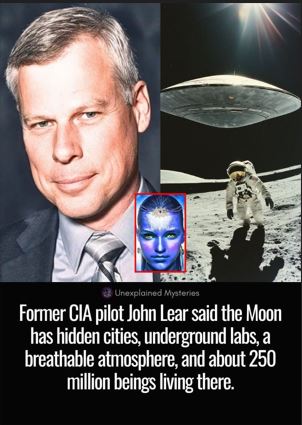
Former Pilot John Lear’s Extraordinary Moon Claims Resurface, Sparking Fresh Debate Online
One of the most controversial figures in UFO history is once again attracting widespread attention after an image circulating across social media revived extraordinary claims made by aviation personality John Lear. The viral post alleges that the Moon contains hidden cities, underground laboratories, a breathable atmosphere, and as many as 250 million intelligent beings living beneath its surface.

The sensational graphic has generated millions of views, reigniting discussions among UFO enthusiasts while prompting scientists and space experts to once again address one of the most remarkable claims ever associated with extraterrestrial conspiracy theories.
Although the story has captured public imagination, there is currently no scientific evidence supporting these extraordinary assertions.
Who Was John Lear?
John Lear was a well-known American pilot recognized for setting aviation records and flying more than 150 different aircraft during his career. The son of inventor William Lear, creator of the Learjet, he became famous within UFO circles during the 1980s after publicly discussing theories involving secret government programs, extraterrestrial civilizations, and hidden technologies.
Unlike many witnesses who described isolated UFO sightings, Lear presented an expansive narrative involving alleged underground alien bases, recovered spacecraft, classified military projects, and civilizations beyond Earth.
His claims became highly influential among UFO researchers and conspiracy theorists, despite never being independently verified.
The Viral Moon Allegations
The latest viral image repeats several of Lear’s most famous assertions.
According to the claims, the Moon is far more than a barren satellite orbiting Earth. Instead, it allegedly contains vast underground cities connected by tunnels, advanced laboratories, and even a breathable atmosphere beneath the lunar surface.
The post further claims that approximately 250 million intelligent beings reside inside the Moon, living in concealed civilizations beyond the reach of human exploration.
Some versions of the story suggest these inhabitants belong to ancient extraterrestrial races that have occupied the Moon for thousands—or even millions—of years.
Others speculate that hidden entrances exist beneath massive lunar craters, allowing spacecraft to travel into enormous underground caverns invisible to orbiting satellites.
However, none of these claims have been supported by evidence collected during decades of lunar exploration.
What Science Says
Since the Apollo missions of the late 1960s and early 1970s, scientists have accumulated an enormous amount of information about the Moon.
Astronauts returned hundreds of kilograms of lunar rock samples, installed scientific instruments, and conducted extensive geological surveys.
In recent decades, spacecraft from NASA, the European Space Agency, Japan, China, India, and other space agencies have mapped nearly every region of the lunar surface in extraordinary detail.
These missions have revealed lava tubes, volcanic formations, impact basins, and deposits of water ice near the lunar poles.
While lava tubes could one day serve as natural shelters for future human explorers, scientists have found no evidence of hidden cities, underground civilizations, breathable atmospheres, or intelligent inhabitants.
Measurements also show that the Moon possesses only an extremely thin exosphere rather than an atmosphere capable of supporting human life.
Why the Theory Persists
Despite the absence of supporting evidence, theories involving secret lunar civilizations continue to thrive online.
Part of their appeal comes from the fact that humans have explored only a tiny portion of the Moon directly. Vast regions remain untouched by astronauts, allowing imagination to fill the gaps left by limited human presence.
Science fiction has also played a significant role.
Movies, television series, novels, and video games have frequently portrayed the Moon as home to hidden alien bases, ancient ruins, or advanced civilizations.
These fictional stories often become intertwined with real historical events, making it difficult for some audiences to distinguish entertainment from documented science.
Experts Encourage Critical Thinking
Planetary scientists emphasize that extraordinary discoveries require extraordinary evidence.
Modern lunar orbiters continuously photograph the Moon at resolutions capable of identifying objects only a few feet across.
In addition, multiple independent space agencies monitor the lunar surface using different instruments and technologies.
If enormous underground cities, active laboratories, or large populations existed, experts say they would likely leave detectable geological, thermal, or electromagnetic signatures.
To date, no such evidence has been presented through peer-reviewed scientific research.
Continuing Fascination with the Unknown
Although John Lear’s claims remain unverified, they continue to fascinate millions of people interested in UFOs, secret space programs, and the possibility of extraterrestrial intelligence.
His theories have inspired documentaries, books, podcasts, and countless online discussions exploring humanity’s place in the universe.
At the same time, scientists continue searching for evidence of life beyond Earth through missions to Mars, the icy moons of Jupiter and Saturn, and distant exoplanets orbiting other stars.
These investigations rely on measurable data, repeatable observations, and rigorous scientific analysis rather than speculation alone.
The Bottom Line
The renewed attention surrounding John Lear’s statements demonstrates how enduring the mystery of extraterrestrial life remains.
While the viral image presents extraordinary claims about hidden lunar civilizations and hundreds of millions of intelligent beings living beneath the Moon’s surface, no credible scientific evidence currently supports those assertions.
For now, the Moon remains one of humanity’s most extensively studied celestial neighbors—still full of geological mysteries, but not confirmed to contain hidden cities or alien civilizations. As future lunar missions continue to explore its surface and subsurface, scientists hope new discoveries will deepen our understanding of Earth’s closest companion, even if they ultimately reveal natural wonders rather than the extraordinary world imagined in decades of UFO lore.