David Grusch Predicts Major UFO Disclosure Within 60 to 90 Days, Renewing Global Speculation
WASHINGTON, D.C. — Public interest in unidentified anomalous phenomena (UAPs) has surged once again following widespread online claims that former U.S. intelligence officer and UFO whistleblower David Grusch believes significant government disclosure could occur within the next 60 to 90 days. The reports, which have spread rapidly across social media, suggest that new testimony, classified documents, and additional witnesses may soon reshape the public conversation surrounding one of the world’s most controversial mysteries. Although no official government announcement has confirmed such a timeline, the claims have reignited intense debate among researchers, lawmakers, and the general public.

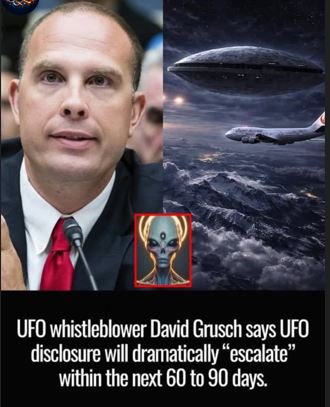
The viral image accompanying the story features David Grusch alongside an artistic depiction of massive unidentified spacecraft hovering above Earth. The headline claims that UFO disclosure is expected to “dramatically escalate” in the coming months, fueling speculation that governments may be preparing to release additional information regarding unidentified aerial phenomena.
Grusch first entered the international spotlight after publicly alleging that the U.S. government possesses information about recovered non-human technology obtained from unidentified craft. He has also claimed that multiple individuals involved in highly classified programs shared information with him regarding long-running retrieval and reverse-engineering efforts. While these statements generated worldwide attention, government agencies have neither confirmed nor verified the extraordinary allegations.
Supporters argue that Grusch’s background lends credibility to his concerns. Before becoming a public whistleblower, he worked within the U.S. intelligence community and served on government task forces responsible for analyzing unidentified aerial phenomena. His testimony before members of Congress marked one of the most closely watched hearings in the history of the UAP debate.
According to the latest rumors circulating online, Grusch believes additional witnesses with direct knowledge of classified programs could soon come forward. Some reports suggest that former military officers, intelligence personnel, aerospace contractors, and scientists may provide new testimony under legal whistleblower protections. If accurate, such developments could significantly expand the ongoing discussion surrounding unidentified aerial incidents.
However, experts caution that no verified evidence currently confirms the widely shared “60 to 90 day” disclosure timeline. Neither Congress nor the Department of Defense has announced plans for a major public release matching the claims presented in viral posts. As with many stories circulating online, the absence of official confirmation has led analysts to urge caution before accepting sensational headlines.
Despite this uncertainty, interest in UAP investigations continues to grow. Over the past several years, the U.S. government has acknowledged that military personnel have encountered aerial objects displaying unusual flight characteristics that remain unexplained after initial analysis. Several Navy videos released through official channels sparked renewed scientific and public interest, leading to congressional hearings and the establishment of offices dedicated to investigating unidentified aerial phenomena.
Importantly, defense officials consistently emphasize that “unidentified” does not automatically mean extraterrestrial. Many cases are eventually explained as drones, balloons, atmospheric phenomena, sensor anomalies, or classified technology. Others remain unresolved simply because investigators lack sufficient data to determine their origin with confidence.
Scientists have largely adopted a cautious but increasingly open-minded approach. Rather than dismissing unusual reports outright, many researchers advocate collecting better evidence through advanced radar systems, infrared sensors, satellite observations, and high-resolution optical imaging. Organizations such as independent university research groups and civilian scientific projects continue developing technologies designed to gather objective data instead of relying solely on eyewitness accounts.
The possibility of future government transparency has also become a recurring topic in Congress. Several lawmakers from both major political parties have argued that national security and public accountability require clearer reporting standards regarding unexplained aerial incidents. Proposed legislation has sought to improve whistleblower protections while encouraging agencies to review historical records related to UAP investigations.
Public fascination has only intensified with the rise of social media. Every new military video, unexplained radar event, or leaked document quickly generates worldwide discussion. At the same time, experts warn that advances in artificial intelligence have made digitally created images and videos increasingly difficult to distinguish from authentic recordings. As a result, investigators now place greater emphasis on original source material, metadata analysis, and corroborating sensor data before drawing conclusions.
Skeptics argue that extraordinary claims require extraordinary evidence. To date, no publicly available information has conclusively demonstrated that Earth has been visited by extraterrestrial civilizations or that governments possess confirmed non-human spacecraft. While some incidents remain unexplained, unresolved cases should not automatically be interpreted as proof of alien technology.
Supporters of greater disclosure counter that continued transparency is essential regardless of the ultimate explanation. Whether unusual sightings involve foreign surveillance systems, experimental aircraft, natural atmospheric effects, or entirely unknown phenomena, they argue that scientific investigation benefits from openness and independent review.
If additional witnesses do emerge in the coming months, their testimony will likely face intense scrutiny from journalists, scientists, intelligence officials, and members of Congress alike. Any new claims would require supporting documentation, physical evidence, or independently verifiable data before fundamentally changing the current understanding of unidentified aerial phenomena.
For now, the viral assertion that David Grusch expects a dramatic escalation in UFO disclosure within the next 60 to 90 days remains unverified. Although his previous public statements continue to influence the global conversation surrounding UAPs, no official announcement has confirmed the specific timeline now circulating online.
Nevertheless, the story reflects a broader shift in how governments, scientists, and the public approach one of humanity’s most enduring mysteries. What was once dismissed as fringe speculation has evolved into a subject of serious national security discussions and scientific curiosity. Whether future disclosures reveal misunderstood technology, classified defense programs, or discoveries that challenge our understanding of the universe, the search for reliable evidence—and the demand for transparency—shows no sign of slowing down.