As an Amazon Associate we earn from qualifying purchases.

The 1957 incident at Edwards Air Force Base (Edwards AFB) remains one of the most discussed unidentified aerial phenomena linked to astronaut Gordon Cooper. This account provides historical context, technical specifics about the camera systems in use, an outline of the reported chain of custody for the film, comparisons with contemporaneous military sightings, and a balanced review of skeptical interpretations.
Background: Gordon Cooper’s Role at Edwards AFB
At the time, Cooper was a United States Air Force officer assigned to the high-desert test ranges surrounding Edwards AFB, home of the Air Force Test Center. He served as a test pilot and project manager, roles that demanded precise documentation of flight activities, including calibrated photography used for performance analysis and safety reviews. Cooper later became one of the original Mercury Seven astronauts, which added public interest to any account associated with his name. His later public statements—most notably in interviews and in his memoir—have been central to keeping the 1957 case in the public eye.
The Reported Incident: May 3, 1957
Technical Setup
Cooper oversaw a precision photography project that involved a camera crew assigned to record test aircraft maneuvering over a dry lakebed. Contemporary accounts reference the use of a cinetheodolite system—a specialized optical instrument capable of tracking flight paths at measured frame rates for engineering analysis. The worksite was a dry lake area commonly used for landings and ground-effect testing, where visibility is generally excellent and foreground distance cues are reliable.
The Observation
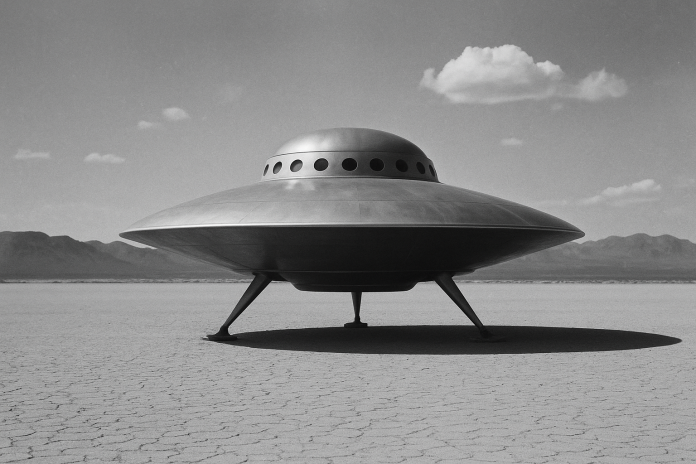
According to Cooper’s later retelling, members of the camera crew entered his office in a distressed state and reported that a silent, saucer-shaped craft descended to the lakebed. They stated that the object extended three landing supports, settled on the surface for a brief period, and lifted off without any audible propulsion signature as they approached to film it. The crew indicated that they captured still images and motion-picture footage of the approach, landing, and departure sequence.
- Reported geometry: “saucer-shaped” planform with three extended landing legs
- Acoustic profile: described as silent during descent, hover, landing, and liftoff
- Distance and perspective: sighted at close range on a flat lakebed with clear lines of sight
- Recording media: still photography and motion-picture film reportedly exposed
Aftermath and Film Handling
Cooper later stated that he followed standard protocols by contacting a designated number and arranging for the film to be processed and delivered to higher headquarters in Washington, D.C. He said he viewed the developed material prior to forwarding it and believed it matched the crew’s description. Cooper also said he did not receive formal feedback after the material left the base. Readers should note that while such a chain-of-custody narrative is consistent with Cold War–era handling of sensitive imagery, the lack of a publicly accessible archival record leaves the evidentiary trail incomplete. For background on the period’s official studies, see Project Blue Book.
Edwards AFB in Context
Edwards AFB served as the epicenter of postwar American flight testing. The high desert provided controlled airspace, expansive landing areas, predictable weather, and the infrastructure needed for advanced aeronautical research. Test pilots and engineers at the site worked on cutting-edge platforms and systems under strict security, which heightened both the plausibility of unusual observations and the possibility of misidentifications. The base’s reputation as a hub for experimentation is well documented in resources about the Air Force Test Center and U.S. military aviation history.
Technical Notes on Cinetheodolites and Instrumented Filming
A cinetheodolite is engineered to measure angular positions of a target while simultaneously recording imagery at a known frame rate. When paired with a second synchronized unit across the field, analysts can reconstruct trajectories through photogrammetry, calculate angular rates, and estimate velocities and altitudes. These instruments were common at military ranges during missile tests and high-speed aircraft trials. Their use at dry lakebeds offered a robust method for collecting kinematic data, assuming calibration logs and timing data are preserved—elements that, in this case, have not surfaced in the public domain.