3I/Atlas is not just any interstellar visitor; it is the third such object ever detected entering our solar system. Traveling at a staggering speed of nearly 68 kilometers per second, it currently races inside Mars’s orbit, accelerating as it approaches the sun. This hyperbolic trajectory sets it apart from typical comets or asteroids, putting it on a path that will take it closest to the sun on October 29th at about 1.36 astronomical units—between the orbits of Earth and Mars.
NASA and international space agencies have marshaled an unprecedented fleet of orbiters around Mars to monitor 3I/Atlas as it brightens in ways that defy standard comet models. Unlike Earth, whose telescopes will soon be blinded by the sun’s glare, Mars orbiters have a clear line of sight, providing a rare vantage point to observe this enigmatic visitor’s behavior in real time.
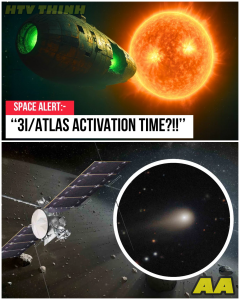
The question scientists are racing to answer is whether 3I/Atlas is “activating” — undergoing outbursts, releasing gas and dust, and displaying the hallmark characteristics of a comet. Activation would signify that solar heat is driving volatile materials to escape its surface, creating a coma and tail that evolve dynamically as it nears the sun. If 3I/Atlas activates, it would challenge existing cometary models and offer unprecedented insight into the chemistry of interstellar objects.
On October 3rd, 3I/Atlas passed within 0.20 astronomical units of Mars, a close approach that allowed six orbiters—including NASA’s Mars Reconnaissance Orbiter and Maven, ESA’s Mars Express and ExoMars Trace Gas Orbiter, China’s Tianwen-1, and the UAE’s Hope spacecraft—to target it simultaneously. However, these spacecraft were not designed to chase faint, fast-moving objects like 3I/Atlas, which shines at magnitude 12 — tens of thousands of times dimmer than Mars itself.
Despite these challenges, mission teams have pushed their instruments to the limits. Long-exposure imaging and spectrometry have been employed to detect even the faintest signals of gas or dust emissions. Each successful observation is a hard-won triumph, reflecting intense coordination and technical skill.
A striking moment came on October 2nd when NASA’s Perseverance rover on Mars captured an unexpected streak in its nighttime images. This diagonal line matched predictions for 3I/Atlas’s trajectory, suggesting the rover had photographed the object as it swept across the Martian sky. The discovery was first flagged by an amateur astronomer browsing public data, sparking a wave of excitement and debate.
Scientists quickly began verifying the streak’s authenticity, considering alternative explanations such as cosmic rays or satellites. The process highlighted the importance of open data and citizen science, as the global community joined in the hunt for truth. This collaborative spirit underscores the tension between rapid discovery and rigorous validation.
However, on October 21st, 3I/Atlas will disappear behind the sun from Earth’s perspective, entering a blackout period known as superior conjunction. During this time, ground-based telescopes cannot observe it, leaving Mars orbiters as the sole observers. This creates a bottleneck in data flow, as agencies debate when and how to release observations.
Some scientists advocate for immediate open access to encourage global collaboration, while others caution that releasing raw, uncalibrated data could fuel misinformation and premature claims. These competing priorities have led to embargoes ranging from hours to days, frustrating both professionals and citizen scientists eager for answers.
The blackout period has become a crucible for speculation. Rumors swirl about possible activation events, outbursts, or even artificial origins, often fueled by delays and gaps in publicly available data. Meanwhile, official channels emphasize patience and caution, warning against jumping to conclusions without robust evidence.
At the heart of the investigation lies a suite of chemical markers. One key focus is the ratio of carbon dioxide to water vapor in 3I/Atlas’s coma. Observations from the James Webb Space Telescope and the Very Large Telescope indicate an unusually high ratio of about 8:1, far exceeding typical solar system comets, which rarely surpass 1:1. This suggests a fundamentally different composition and outgassing behavior.
Another puzzle is the presence of strong atomic nickel lines detected in high-resolution spectra, without accompanying iron lines. Scientists hypothesize that a volatile compound called nickel tetracarbonyl, found in cold, carbon-rich environments, may release nickel atoms when exposed to sunlight. Tracking changes in these spectral lines as 3I/Atlas approaches perihelion could reveal whether fresh material is being exposed or fragmented.
The iconic green glow commonly seen in comets, caused by C2 molecules, is notably absent here. Instead, the faint greenish tint likely results from fine dust scattering and possibly nickel fluorescence. If perihelion triggers a surge in C2 production, it would signal classic cometary activation. Otherwise, the object’s behavior may be dominated by dust and exotic chemistry.
Scientists are closely monitoring any sudden changes in brightness, tail structure, or coma expansion—signs that could indicate fragmentation or outbursts. Each of these phenomena would provide crucial clues about the physical and chemical processes occurring on and near 3I/Atlas.
The final verdict on whether 3I/Atlas “activates” remains pending. The comprehensive analysis requires tracking multiple markers over time, especially as the object passes perihelion. This patient, methodical approach reflects the complexity of studying interstellar visitors that challenge conventional models.
Beyond the scientific intrigue, the mission highlights the importance of international cooperation and transparency in space exploration. The global community’s combined efforts—from professional researchers to amateur astronomers—are essential to unlocking the secrets of objects like 3I/Atlas.
As we await the full release of data and prepare to observe 3I/Atlas’s return in December, one thing is clear: this interstellar visitor is rewriting the rules of cosmic chemistry and challenging our understanding of what it means to encounter material from beyond our solar system.
The story of 3I/Atlas is far from over. Its approach, activation, or quiet passage will shape future missions and theories, reminding us that the universe still holds many mysteries waiting to be unveiled.